You're Asking the Wrong Question
Ask someone to explain the difference between a universe, a galaxy, and a solar system, and you get a clean answer. It's about scale. Earth sits inside a solar system. The solar system drifts inside a galaxy. The galaxy floats inside an endless universe. Nested. Organized. Easy.
Now ask someone why their small home solar system keeps underperforming, and the answer is anything but clean. "The batteries are dying again." "The inverter shuts down in the middle of the day." "We lose power every time it's cloudy for two days." So they go shopping: new inverter, extra panel, bigger battery. They swap parts. Three months later, the same problem is back.
I'm a quality compliance manager at Morningstar, a company that builds charge controllers and remote monitoring systems for off-grid solar. For over four years, I've reviewed controllers before they ship—300 to 500 units a week, give or take. I've rejected roughly 1.4% of first-pass assemblies in 2025 for failing tolerance checks. I know where systems fail in the field, because I see the parts that come back.
The problem is rarely the inverter, the panels, or the batteries. It's the charge controller. Not because it's expensive—it isn't. But because it's the most under-specified, under-tested, and under-monitored part in the entire system.
The Part Nobody Thinks About
Here's something vendors won't tell you: most budget charge controllers look fine on the spec sheet and fail quietly in the field. They'll charge a battery. They'll hold a voltage. But the tolerances are loose, the temperature compensation is weak, and the monitoring data they provide is almost useless.
In testing, our Morningstar MPPT controllers regulate charging voltage within 0.1V of the target—and we verify that on every unit before it ships. Budget controllers we've tested can drift three to five times that much. What does that mean practically? When a controller overcharges by half a volt day after day, you don't see it on a blinking LED. You see it eighteen months later, when the battery bank is dead.
Everything I read about solar in my early years told me charge controllers are a solved problem. Pick the amperage. Match the voltage. Move on. In practice, that's dangerously incomplete. The charging algorithm isn't a minor feature—it's what decides whether your batteries last four years or eight. A cheap controller can be 80% right, which sounds fine until 80% right destroys a 48V battery bank two years early.
The other issue is visibility. Most budget controllers give you three LEDs and, if you're lucky, a small screen showing current voltage. You don't get charging history. You don't get battery voltage trends. You don't get error logs. So when something starts going wrong, you have no way to know until it's too late.
What "Cheap" Actually Costs
Here's a case from our Q1 2024 quality audit. We examined an off-grid system that had been unreliable for over a year. The owner had already replaced the inverter, upgraded the panels, and added a second battery. He was ready to give up on solar entirely.
We found the problem in the charge controller. It was a budget unit rated for 40A, and it was charging at 14.8V when the battery datasheet specified 14.4V absorption. That extra 0.4V, sustained over months, had caused the battery bank to lose nearly half its rated capacity.
The damage: two replacement batteries at $720 each. Four service visits at $150 an hour. Four days without power. And the controller? It had cost $40 less than a quality MPPT controller. $40 of savings turned into a $2,000 bill. That math isn't an edge case—it's the norm when you let a cheap controller run an expensive system.
For B2B installers, the calculation gets even worse. A client whose system fails is a client who calls you. The first service call is "free" because you don't want to burn the relationship. The second one, too. Before long, you've burned $600 in labor on one small home solar system, and the client's neighbor hears the story and decides to use someone else. The damage isn't just technical—it's reputational.
Bottom line: the cheapest system isn't the one with the lowest component prices. It's the one with the lowest total cost over its lifetime. That's not a slogan. It's arithmetic.
Design the System, Not the Parts
So what should you do? Stop asking "which component should I buy" and start asking "how will these components work together for the next five years?" This is where the universe vs galaxy vs solar system analogy comes back. The nesting is clear: small systems inside larger systems. But most people debug at the wrong level. They blame the panel when the real issue sits at the integration level—how the charge controller, batteries, and inverter coordinate.
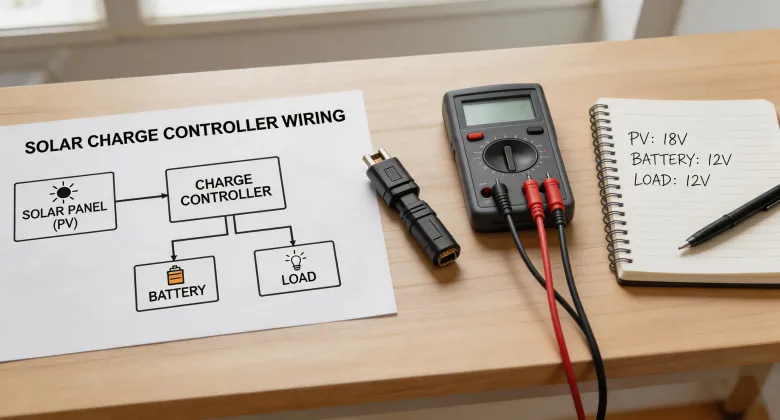
The charge controller is that coordination point. It touches everything: solar array, battery bank, loads, and communication. That's why we build monitoring into our controllers as standard. The Morningstar app gives you battery voltage trends, charging status, and error logs from your phone. You can catch a voltage drift weeks—sometimes months—before it ruins a battery bank.
And when you're speccing a system, respect the hierarchy of risk. An inverter—say, an Anern solar inverter if that fits your budget—converts power. That's important. But it doesn't protect your batteries. The charge controller does. I've seen $500 inverters paired with $30 controllers, and every single time, the batteries paid the price.
Buy the best controller you can afford. Make sure it has real monitoring capability. And check the system data regularly—weekly at minimum. That's the difference between a system that lasts a decade and one that dies in two years. I've reviewed enough failed parts to know that pattern by heart.