-
Which Morningstar controller should I spec for a 25kW solar kit?
-
What's the difference between a Morningstar TriStar MPPT and a regular TriStar?
-
How do I know the Morningstar controller is sized correctly for my string config?
-
Does a 25kW solar kit need a Morningstar remote monitoring solution?
-
Can you charge a Tesla at any EV charging station?
-
How do I model a solar system online before buying a Morningstar controller?
-
What quality issues should I watch for when receiving Morningstar controllers in bulk?
-
Is a Morningstar controller worth the cost on a 25kW kit?
If you're pricing out a 25kW solar kit and someone tells you the charge controller is just a formality, I'd push back. I review specifications for renewable energy projects before they reach customers—roughly 200 unique system designs a year. I've rejected about 11% of first submissions in 2025 due to undersized controllers, incompatible voltage ratings, or missing remote monitoring specs. This is not about being picky. This is about preventing a site visit that costs more than the controller itself.
This article answers the questions I actually get from system integrators, in the order I get them.
Which Morningstar controller should I spec for a 25kW solar kit?
The short answer: you don't put one charge controller on a 25kW array. A single Morningstar controller—whether it's a TriStar MPPT or a classic TriStar—tops out well below that. For a 25kW PV array, you're talking about a combiner of multiple controllers, typically three to six TriStar MPPT units depending on array voltage and string configuration.
Here's what most people don't realize: the charge controller bottleneck isn't just the wattage label. It's the current. A TriStar MPPT-60 handles 60A of output current. At 48V battery nominal, that's roughly 3,000W to 3,500W of PV. So for 25kW, you need multiple units, and you need to split the array into sub-arrays that each respect the controller's Voc limit.
If you're asking "can one Morningstar charge controller run my whole 25kW kit," the answer is no. Plan for a distributed design from day one.
What's the difference between a Morningstar TriStar MPPT and a regular TriStar?
This is a common mix-up. The standard TriStar is a PWM controller. The TriStar MPPT is a different product line with maximum power point tracking. They're not interchangeable.
The TriStar MPPT takes a higher PV input voltage and down-converts it to charge the battery more efficiently. For a 25kW solar kit, you want MPPT you'd be losing a meaningful chunk of harvest with PWM, especially in cooler climates where array voltage runs high.
The "this was true 10 years ago" moment: PWM used to be the default because MPPT controllers were expensive and the efficiency gain didn't justify the cost on small systems. Today, on a 25kW scale, the efficiency difference pays for the controller upgrade within the first year on most sites.
How do I know the Morningstar controller is sized correctly for my string config?
Check three numbers, in this order:
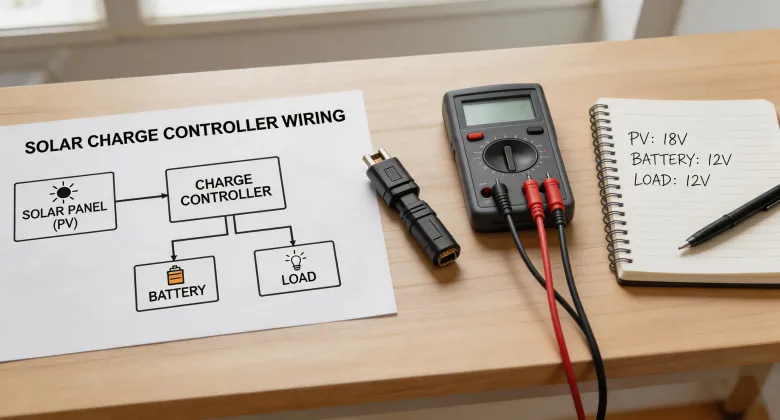
- PV input voltage (Voc): The absolute max Voc of your string at coldest temperature must stay below the controller's limit. TriStar MPPT-60 handles up to 150V or 200V depending on model.
- Output current: Max charge current per controller. 60A is common. You don't exceed this under normal operation.
- Battery voltage: 12V, 24V, 48V. The controller's output rating changes with system voltage.
Let me give you a real scenario. In Q1 2025 we received a batch of BOMs where the integrator had spec'd a single TriStar MPPT-60 for a 6kW sub-array on a 48V bank—that's over 100A of potential charge current. The controller would have throttled hard, and the customer would have complained about lost harvest.
We rejected the design and the integrator redid it. Now every contract we review includes a string sizing calculation attached to the BOM.
Does a 25kW solar kit need a Morningstar remote monitoring solution?
If you're asking this after the system is installed, that's backward. I would argue remote monitoring is not an accessory for a 25kW kit. It's part of the truck roll prevention plan.
Here's something vendors won't tell you: the most expensive part of a solar installation isn't the panels or the batteries. It's the truck roll. When a customer says "my system isn't charging," and someone drives two hours to site only to find a tripped breaker, that's a $400 visit that could have been a 10-minute check in the portal.
Morningstar's remote monitoring options—including the Morningstar Portal and the logging controllers with Ethernet or cellular add-ons—let you see harvest data, battery voltage, and fault history. For a 25kW commercial install, I'd treat that as a requirement, not an upgrade. At his scale, you can't eyeball the batteries.
Can you charge a Tesla at any EV charging station?
I get why this comes up. Anyone spec'ing solar and batteries starts thinking about EV charging, and the name "charging station" seems universal. But no—you can't charge a Tesla at every EV charging station.
Tesla vehicles use the NACS connector (North American Charging Standard, formerly the proprietary Tesla connector), though newer Teslas in some markets use CCS compatibility. A standard Level 2 J1772 station won't plug into a Tesla without an adapter. A CCS fast charger with a Tesla connector? Depends on the station and the vehicle's compatibility.
Look, I'm not saying this to embarrass anyone. But when we design solar kits that include EV charging, the charger selection matters just as much as the controller spec. If your client drives a Tesla and the charging station you specced is J1772-only, they'll need an adapter. Fine, but it's a conversation to have upfront, not after installation.
How do I model a solar system online before buying a Morningstar controller?
There's no single "official" Morningstar sizing tool that handles a full 25kW system model online—you typically build the PV array in a design platform, then check the charge controller spec against the sub-array. We've used a few approaches:
- PV-specific design tools: SAM, PVsyst, or Helioscope for array modeling and yield estimation.
- Morningstar's string sizing tool: Use it for the controller-specific voltage and current checks.
- A spreadsheet: Honest answer. A BOM check with Voc limits and current sums catches most issues before you get to the modeling software.
What I recommend: model the array first, then verify the controller. Don't pick a controller and try to fit the array around it.
What quality issues should I watch for when receiving Morningstar controllers in bulk?
I've rejected more than one batch in my career for issues that weren't visible from the outside. Here's the checklist we use:
- Verify the model number on the label matches the BOM. Simple, but you'd be surprised how often a newer revision gets substituted without approval.
- Check the packing for physical damage. Especially the terminal covers and display cables—these get bent in shipping more than you'd think.
- Inspect the terminal blocks for burrs or misalignment. This is rare on Morningstar units, but it can happen in any manufacturing batch. In 2023, we found a batch of eight units where the input terminal lugs had slight burrs—not enough to cause a short, but enough to make torque reading inconsistent. We sent them back.
- Test one unit before installing the whole batch. Wire it to a bench battery and a small PV panel. Confirm it wakes up, reads voltage, and enters charging mode.
That last point is the one people skip. On a 25kW kit, there are multiple units. If you're installing 20 TriStar MPPT-60s and unit #6 is faulty, you don't want to discover it after install at a remote site. Bench-testing one unit from each received batch costs 15 minutes and has saved us substantial rework costs.
Is a Morningstar controller worth the cost on a 25kW kit?
Cost is a decision, not a price tag. Let me put it this way:
The lowest-cost controller from a less established brand might save you $150 per unit. On a six-controller 25kW system, that's $900. If one of those budget units fails during the warranty period, the labor to replace it—the diagnosis, the site visit, the swap—will likely exceed that $900. We've seen it happen.
But I'll also push back on the other side: don't overspec just for brand confidence. A Morningstar TriStar MPPT-60 is the right choice when the project needs proven reliability and where remote troubleshooting matters. For a small 48V off-grid cabin with someone on site every week, a simpler controller could work. But for a 25kW kit with a client who expects reliability, I'd spec Morningstar and justify it by reduced risk, not by claim.
We have 4+ years of reviewing system designs, and the pattern is consistent: the systems that performed best had a few extra dollars in the BOM for proven components, and a few extra hours in the schedule for configuration checks. The systems that struggled were not always the cheapest—they were the least verified.
5 minutes of verification beats 5 days of correction. That's not a slogan. That's my week.