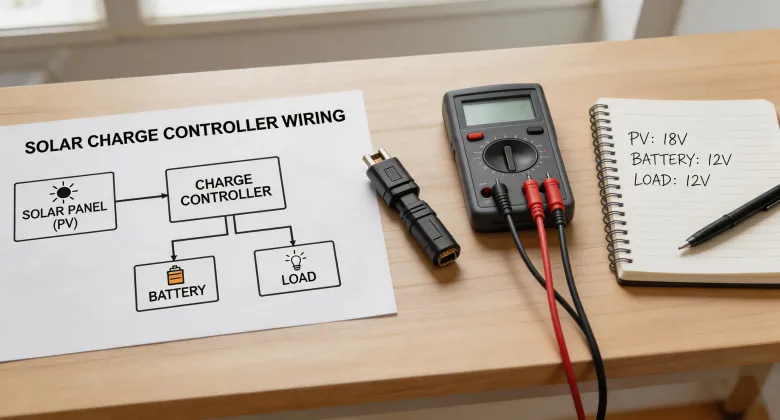
Before I place a purchase order for any Morningstar solar charge controller, I check the temperature-corrected open-circuit voltage (Voc) of the array. It takes about fifteen minutes. It has saved us more money than any price negotiation I’ve run. Choose a controller by its maximum PV input voltage, not by the panel wattage or by the word “MPPT” on the box.
I’m not an engineer. I’m the office administrator who handles purchasing for a solar integrator. Since 2020 I’ve been buying Morningstar products plus inverters, batteries, monitoring hardware, and the rest of the balance-of-system equipment. We spend roughly $350,000 a year across vendors. Maybe $320,000; I would need to pull the exact report before giving you a firm number. My job is to make sure the purchase order line items match the project requirements before anything ships.
The 150W solar panel that reset my checklist
The mistake that changed my process happened in Q1 2023. The project was a remote monitoring station with four 150W solar panels in series feeding a 48V battery bank. Each panel had a nameplate Voc around 22.6V, so the array was about 90.4V at standard test conditions. The controller we had been quoted had a 100V maximum PV input. That looked safe. It was not safe, because PV module voltage rises as temperature drops. At -15°C, that 90.4V array can cross 100V. On the coldest morning after installation, the site sat in fault instead of charging batteries.
I had been warned about this. The senior engineer left a note: “check cold weather voltage.” I skipped it because the order was already late and, honestly, 90V seemed comfortably below 100V. Looking back, I should have asked him to walk me through the calculation. At the time I wanted to keep the PO moving. That is the most expensive phrase in procurement: “the PO is moving.” It works until it doesn’t.
A 150W solar panel sounds small. It is small. But small panels in series still add up, and voltage has no respect for wattage. That is why I no longer trust “it’s only 150W” as a shortcut.
What I check on every Morningstar order
I run a short checklist before I approve a PO. It doesn’t replace the system engineer. It protects the engineer from a buyer who picks the wrong model at the last minute. The non-negotiable items are:
- Cold-weather Voc. Calculate array Voc at the site’s lowest expected temperature, not at standard test conditions. Compare that to the controller’s max PV input voltage on the Morningstar spec sheet. I keep the exact module temperature coefficient; I don’t rely on a generic number.
- Battery voltage and charge current. The controller rating is its charging current on the battery side. It must match the bank voltage and the current the project actually needs.
- Battery chemistry profile. Lead-acid, gel, and lithium all need different charging voltages. Confirm the controller supports the profile or allows custom setpoints.
- Monitoring and login setup. If the site will be monitored, verify the communication device, account access, and commissioning steps are on the quote. Remote visibility is not an accessory; it is a maintenance cost.
The last item creates more support tickets than people expect. Hardware can be flawless, but if the field team can’t get into the monitoring portal, the customer calls us. We now configure the Morningstar Portal access and the Morningstar login app during commissioning, not after the controller is already mounted on a pole.
What changes when the project uses a solar on grid hybrid inverter
Projects with a solar on grid hybrid inverter need one extra conversation. The phrase “hybrid” doesn’t tell me where the PV charging happens. Some hybrid inverters have their own MPPT inputs. Other designs rely on an external solar charge controller. If both are present, the Morningstar controller and the inverter’s internal charger will share the same battery, and their charging setpoints need to work together. Otherwise, one device can behave oddly or disconnect.
From a purchasing view, hybrid inverter projects also have more material on the critical path. The solar on grid hybrid inverter and the charge controller can ship from different locations. If the monitoring gateway was forgotten, the job gets delayed. I add those items to the PO early, not after the boom truck leaves the site.
Where my procurement view runs out
I should be honest about the limits of this checklist. I don’t have hard data on industry-wide controller failure rates. I have not tested every Morningstar product in every climate. What I can offer is experience from five years of purchasing: nearly every expensive correction in our office started with a parameter that someone assumed. The fix is usually a datasheet and fifteen minutes.
Most of this matters on multi-panel or multi-voltage systems. A single 150W solar panel feeding a 12V battery bank through a small PWM controller has much more margin. The dangerous systems are the ones that look simple: several panels in series, a hybrid inverter, a 48V battery, and a schedule that says hurry.
One more thing: because “solar” appears on our website, we occasionally receive strange RFQs. Someone once sent us a subject line that said what planets are in our solar system, followed by a school worksheet. I replied with a NASA link and then asked for the PV module datasheet. It was a funny email, but it made a serious point: solar is an ambiguous word. A solar system here is not planets. It is a set of voltages, temperatures, and battery chemistry profiles. Verify those before you buy, and you will avoid the expensive corrections.