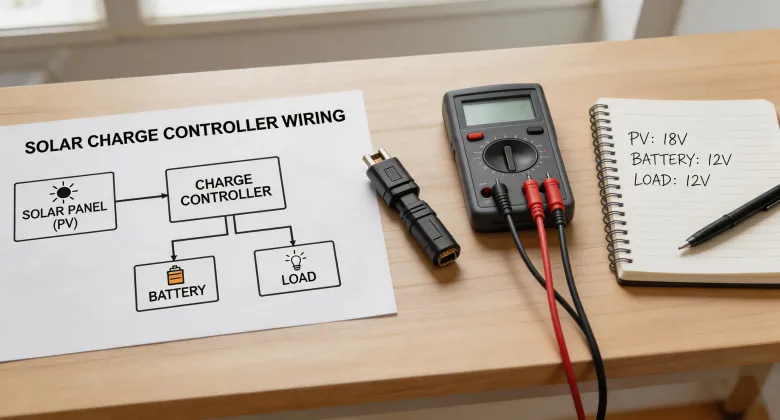
Let me say something that gets me skeptical looks at industry meetups: Morningstar products are not the right choice for every off-grid project. We deploy them on most of our solar sites, and I'd rather use a TriStar MPPT than deal with a controller that isn't field-tested. But 'most' isn't 'all.' And if an integrator says one brand is always the answer, I'd be suspicious.
I'm an emergency support engineer for a renewable energy integration company. I've handled 160+ urgent replacements and site visits in 8 years. In March 2024, a client called at 6 PM from a remote telecom site after their controller died. There was no time for a normal 7-day lead time. We had a spare Morningstar in stock, matched the array voltage to the battery bank, and had the site online before midnight. That's the good side of having a trusted default.
But here's the part that matters more: the right question isn't 'which controller is the best?'—it's 'which controller fits this specific site?' That difference shows up in wind, weird search terms, and temperature curves.
I trust Morningstar products. I just don't trust anyone who says they're right for 100% of renewable energy installations.
The Morningstar Website Is Honest About Its Limits—Pay Attention
In our shop, every project starts with the data sheet, not the logo. If you go to the Morningstar website, you'll see precise input voltage ranges, battery current limits, and operating temperatures. You won't find a wind turbine charge controller wiring diagram. That's not a missing page. It's a boundary. Morningstar products are designed for photovoltaic modules, not for the voltage swings of a wind turbine.
I'm not a wind-turbine engineer, so I won't pretend to give you a universal wind turbine charge controller wiring diagram. What I can tell you from a DC integration perspective is simple: don't wire a turbine output into a Morningstar solar controller. Wind generators produce variable, often rectified, voltage that needs a separate charge controller and a dump load for overspeed protection. We had to replace a client's system after someone wired a turbine into an MPPT controller. It wasn't pretty.
The 'MPPT VFD Solar Inverter' Search Is a Warning Sign
I get emails with that phrase all the time: 'mppt vfd solar inverter.' It usually comes from someone sizing a solar water pump system. An MPPT charge controller, like Morningstar products, takes DC from solar panels and charges a battery bank optimally. A VFD solar inverter is a different machine, often converting DC to variable-frequency AC for motors. Some pump inverters combine MPPT and VFD in one housing. That's not what Morningstar makes.
This distinction matters in an emergency. When a client calls at 4 PM about a dead water pump, I need to know whether the problem is in the controller, the VFD, or the inverter. One project tried to save $90 by using a cheap solar inverter where we had specified an MPPT controller. Within a month the battery bank was chronically undercharged, and the replacement cost more than the original quote. That's a textbook penny-wise, pound-foolish mistake.
Solar Panel Efficiency vs Temperature Curve Is the Real Decision-Maker
Here's the technical issue that separates experienced integrators from spec-sheet checkers: solar panel efficiency vs temperature curve. Most people know that panels lose output in extreme heat. But voltage behavior matters even more. On a cold morning, panel voltage rises—sometimes above the maximum input voltage of the controller. If you ignore the module's temperature coefficient, a 150V MPPT controller can be destroyed by a 120V array that climbs to 170V at -20°F.
In my first year, I made the classic rookie mistake. I sized a controller based on nominal wattage and ignored the cold-weather Voc. The controller fried, the freight bill was $1,100, and the site was down for two days. Since then, we calculate from the datasheet on every project. And that's why we don't assume the same Morningstar TriStar that works in Arizona will work on a substation site in Montana. The panels are different, the wiring distances are different, and the temperature range is different.
Doesn't That Undercut the Brand?
I hear this from salespeople: 'If you tell customers the product might not fit, why would they buy it?' Based on our internal data from 160+ rush jobs, the opposite is true. Last quarter alone, we processed 47 rush orders with a 95% on-time delivery rate. The ones we missed were almost always compatibility misjudgments—not bad products.
My experience is built on roughly 140 off-grid sites, mostly telecom towers and agricultural projects. If you're doing marine, RV, or residential solar, your numbers may differ. That's exactly the point: recommendations need context.
The Bottom Line
Bottom line: Morningstar products are excellent, but they're not the only answer. I've installed them in hot deserts, cold mountains, and sites with generators that behave badly. They fail less than almost anything else we've tested. But 'trusted' and 'always appropriate' are not the same thing.
If you're looking for a wind turbine charge controller wiring diagram, a VFD-based solar pump drive, or a controller that can handle an extreme temperature curve, Morningstar might not be your first call. That's not a bad review. It's a better installation—and in my job, a better installation is what saves the emergency calls.