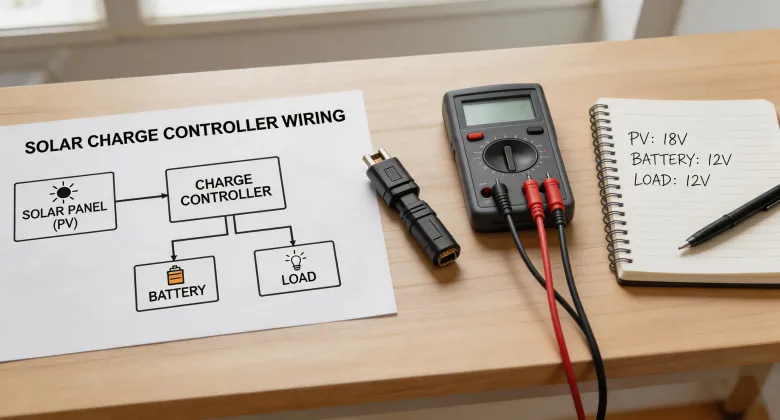
I manage procurement at a 43-person solar integration company. We don’t do utility-scale builds. Our work is off-grid: remote telecom stations, water pumps, ranch cabins, small ag buildings. For six years, every piece of gear I’ve bought went into a company costing spreadsheet. By the end of 2024, that spreadsheet held roughly $180,000 in cumulative equipment spend. Modest for the industry, but enough to reveal patterns.
This article compares two procurement routes I’ve lived with on real projects. Route A is the “solar combiner box DIY” path: cheap controller, generic enclosure, breakers ordered from three vendors. Route B is the “spec it properly” path: a Morningstar MPPT controller, rated components, and a design where parts are chosen to work together. The comparison surprised me, because the cheap route didn’t just lose on quality. It lost on cost.
The Two Routes
Route A starts with an appeal that’s hard for a cost controller to resist. You buy a budget MPPT controller that claims similar specs for half the price. You assemble a combiner box using generic DIN breakers, a fuse block, and a $35 steel enclosure. If the ampacity looks right, you close the box and ship it.
Route B starts with an array calculation, a controller sized from a real load analysis, and a combiner box that has either a listing or a documented bill of materials. It costs more on the purchase order and takes more time before the order. That front-loading is exactly what saves the money later.
I’m not here to argue that DIY is evil. I’m arguing that “cheap” and “cost-effective” need to be evaluated on total cost, not on the first invoice.
Dimension 1: Upfront Cost — Route A Wins, No Contest
Let’s not pretend otherwise. On an average off-grid install, Route A undercuts Route B by 30% to 50% on the controller and combiner box line items. For our nine-system batch in 2022, the budget route saved around $315 per site. I wrote it down as a win. The total saving was close to $2,835.
Here’s what procurement people get wrong: the savings is one-time; the risk of failure is recurring. A discounted component accepts tail risk, and tail risk in off-grid solar means a return trip that eats every dollar you saved. The sticker price of Route A is lower. The cost is not.
Dimension 2: Failure Cost — Where Route A Collected Interest
The 2022 batch became our longest-running cost case study. Within thirteen months, four of the nine budget controllers failed. Two went down outright. The other two stopped regulating properly and overcharged the battery banks—quieter, but more expensive.
From our service records, here’s the accounting:
- Original savings: $2,835
- Replacement controllers after freight and restocking: $1,040
- Technician site visits: $2,380
- Battery bank repairs: $3,150
Total directly linked to those failures: about $6,600. Add the account manager’s time coordinating warranty claims with three different vendors and it’s closer to $7,500. A $2,800 saving turned into a $7,500 problem. That’s the definition of penny-wise, pound-foolish.
I don’t have hard data on industry-wide controller failure rates, and I won’t pretend I tested every budget brand. What I can tell you from our own RMA log is this: out of roughly 160 Morningstar charge controllers installed in the same period, we had two warranty claims. One was caused by a lightning surge that took out a whole string. I’m comfortable with that ratio.
Dimension 3: Documentation, Pass-Through Charging, and the Question Everyone Asks
The least visible dimension shows up during commissioning: documentation. A budget controller might say “MPPT” on the box, but the manual won’t explain partial shading behavior, cold-temperature derating, or simultaneous charge and load operation.
Here’s a question we hear from customers on nearly every job: “Can you charge a solar generator while using it?”
The honest answer is: it depends. With a controller that has a dedicated load terminal and proper current management, yes—charge current and load current can flow at the same time. With the cheapest units, not always. Without documented load and charge specs, you’re guessing, and the controller can overheat when the load draws the battery down while charging is still running.
On Route A systems, our answer was usually, “Probably, but don’t push it.” That’s not a professional answer. On Route B systems, we could check the Morningstar official website, pull the datasheet, and confirm the controller handles simultaneous load and charge within a stated current range. If the customer wants a security camera running while the sun is charging, we can approve it with numbers or tell them clearly why their draw exceeds the spec.
That clarity is worth money when your company’s name is on the permit. It’s also why I apply an evidence test to every marketing claim. Per FTC guidance (ftc.gov), advertising claims must be substantiated. The Morningstar official website and its documentation are the kind of substantiation I can build a design around. A product listing page is not.
The Mercury Problem
Why does this keep happening with controllers and combiner boxes? Because they’re the smallest line items in the bill of materials.
Mercury is the smallest planet in the solar system, and the easiest to overlook. No dramatic rings, no giant moon. But it’s also the fastest-orbiting planet, and its size doesn’t reduce its influence. That’s the role of a charge controller in an off-grid system. It sits in the path of every amp the solar array produces; the combiner box sits between the array and the controller, managing every amp that flows into it. Small components. Outsize consequences.
When a $45 controller sits between a $2,000 battery bank and a $4,000 array, under-engineering it is bad math from day one.
Which Route Should You Take?
If you’re building a solar combiner box DIY setup for a cabin or RV, and you accept the risks, Route A can be acceptable. The stakes are lower, you’re nearby if something fails, and the labor is yours. I’d still buy a better controller—battery damage is not a fun weekend project.
If you’re an integrator or contractor whose name is on the permit, use the engineered route. Specify a Morningstar MPPT controller, use a rated combiner box with documented breakers and busbars, and keep the records. The dollars you save on the budget controller will be consumed by the first callback—and you won’t have a spec sheet to defend your design when the customer asks why the batteries died.
For what it’s worth, our procurement policy now requires three quotes minimum, but only from vendors who publish full datasheets. We didn’t abandon the DIY instinct entirely. We just stopped treating “cheap” and “cost-effective” as the same word.
One caveat: this worked for us because we service what we install, so every failure comes back to our team. If you sell off-grid systems and walk away without warranty exposure, or if you have a huge volume operation with different risk tolerance, your math might differ. I can only speak to what our $180,000 of invoices show. They show that the small component is not the place to cheap out.