If you've ever been asked to recommend an off-grid solar setup, you know why there is no single right answer. A unit that works for a two-day camping job is not the same as a unit that keeps a water pump running for twelve months. I coordinate rush replacements and emergency commissioning for off-grid installers, and the first thing I do on every call is separate the situation from the sales story.
In March 2024, 36 hours before a project had to go online, an integrated solar inverter stopped talking to the battery bank. We sourced a 500V MPPT charge controller through a Morningstar distributor, re-ran the string wiring, and got the site charging before the deadline. On the same day I had a customer trying to run a small workshop from a portable solar generator. The two conversations had one thing in common: people were choosing equipment by category, not by real use.
This is a scenario guide, not a list of the loudest product claims. By the end, you should be able to say whether you need an all-in-one solar generator, a small off-grid inverter, or a modular MPPT system with Morningstar monitoring.
What the words actually mean
Take the common question: how does the Jackery solar generator work? The honest answer is simple. A solar panel connects to a box that contains a solar charge controller, a battery, and an inverter. The unit charges from the sun, charges from the wall, and feeds power to DC or AC outlets. It is basically a complete system in one tidy box.
That simplicity makes it attractive. It also makes it hard to repair. If the built-in charge controller fails in a portable unit, the whole unit often has to go back for service. In a modular system, you can replace one component and leave the rest online.
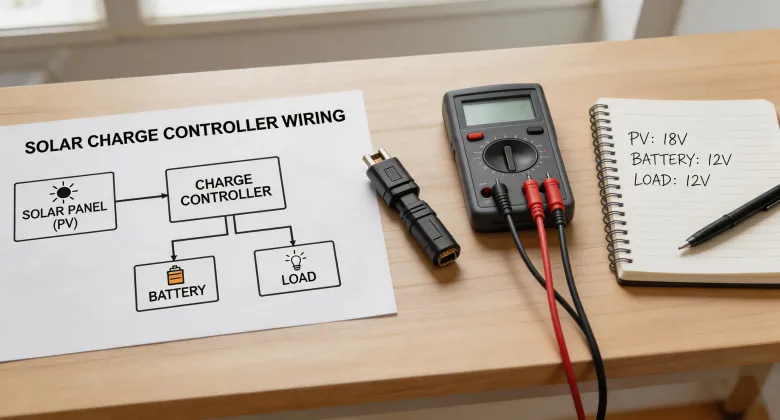
An MPPT charge controller does one main job. It takes DC power from the solar array and converts it to the correct voltage for a battery bank. That is why a 500V MPPT charge controller can matter. Higher string voltage from the panels can be stepped down efficiently to charge a 24V or 48V battery system. Then a separate inverter turns battery DC into AC for lights, tools, and appliances.
The three scenarios I use before recommending a product
1. Portable power for a crew, event, or temporary site
If the system has to move with people and the daily load is small, the all-in-one portable route is usually right. A Jackery solar generator is a good example. Use it for lights, laptops, medical devices, phone charging, and tools that only run for short bursts.
Make sure you understand its limitation. The solar panel is the engine of this system, and the battery is only a storage tank. If you get three days of clouds, a large battery will still be empty unless you can recharge from another source. That is why I tell people to size the panel before they size the battery. It goes against the default habit of buying a bigger unit, but I've seen too many large portable power stations sitting next to undersized panels.
The same logic means a portable solar generator is not the right answer for a 2.2kW continuous load. If the client needs to run a pump or a heater overnight, move to the next scenario.
2. Fixed backup or small premises with a real load
The next scenario is a house, shop, security post, or telecom cabinet where the system stays in one place and has a defined load. A common starting point is an all-in-one inverter like the Inverex Aerox 2.2kW off-grid solar inverter. It converts battery DC power into usable AC and usually has a built-in MPPT solar input. For a small system, that is a legitimate option.
There is one detail I always check before I recommend that path: what happens when the job grows. If the client later adds more panels, a small all-in-one unit can become the bottleneck. Its internal MPPT input has voltage and current limits, and the inverter has a fixed AC rating. Once you hit those limits, the options get messy. I've made that mistake myself. Years ago I helped spec an all-in-one inverter for a cabin because it was cheap and compact. The first summer was fine. Then the owner added a freezer, and we had to redo part of the power system. The product wasn't defective. My shortcut was. I hadn't asked the obvious expansion question.
When the client wants room to grow, I usually separate the charge controller from the inverter. That path costs more upfront and takes more wall space, but a failure in one part does not shut down the whole system. If the solar array is far from the battery, a separate high-voltage controller also lets you run longer PV strings with less wiring loss.
3. Permanent infrastructure where downtime hurts
The third category is the one I deal with most. A site has to work all year, with no technician in the building. For that kind of reliability, I do not rely on a one-box appliance. I build the system in blocks: solar panels, a serious charge controller, a battery bank, and an inverter.
For larger arrays, a 500V MPPT charge controller is my first choice. It lets the installer use higher DC array voltage and lower current on the long wire run from the panels to the battery room. That reduces voltage drop and copper cost while giving the controller enough headroom for cold mornings, when panel voltage climbs.
This is also where repairability becomes more important than efficiency. Comparing a one-box system and a modular Morningstar setup side by side makes me realize that the cheapest first bid is not the cheapest system when the whole unit has to be replaced after one board fails. In a modular system, one bad part can be swapped without taking the load down.
On permanent sites, I also insist on remote visibility. The Morningstar app, connected to the charge controller, shows battery voltage, charge current, and fault states without a site visit. I have used it to tell a client that their battery was dropping under load, which is a different problem than a failed charge controller. That data saves the customer the cost of a meaningless truck roll.
And once you know the exact controller you want, buy a spare from the Morningstar store before you need it. A matching revision, mounting kit, and communication accessory are worth more than the rush freight you save later. I order one spare for long-term sites because an overnight replacement can mean the difference between a blip and a week-long outage.
How to tell which scenario you are in
If you are still not sure, use the three checks below. They have saved me from more bad recommendations than any product review.
- Will the system move more than once a year? If yes, and daily energy is under a few kilowatt-hours, a portable all-in-one like a Jackery is a defensible answer. If no, keep reading.
- Is the load small enough for one inverter output? If the client needs lights, internet, and a few outlets, an inverter like the Inverex Aerox 2.2kW off-grid solar inverter is enough for today. Ask what loads might appear in the next three years before you commit.
- What happens if the system is down for 48 hours? If the answer includes lost production, lost data, or a water pump failure, do not build the system around a compact appliance. Separate the charge controller from the inverter and use a 500V MPPT charge controller with monitoring.
If you answered yes to the third question, the Morningstar app and a clean source of spare parts are not extras. They are part of the system design.
My final rule is simple: buy the smallest system that keeps the critical load alive in the worst week of the year, and make sure every component can be replaced without replacing the whole power system. If that rule leads you to a high-voltage MPPT controller from the Morningstar store and a Morningstar app on your phone, the system is probably going to outlast the marketing story.
Check the manufacturer's published specifications before you order. As of April 2025, charge controller model numbers and firmware versions still decide what fits, and no product category can make up for an unanswered question about your actual load.