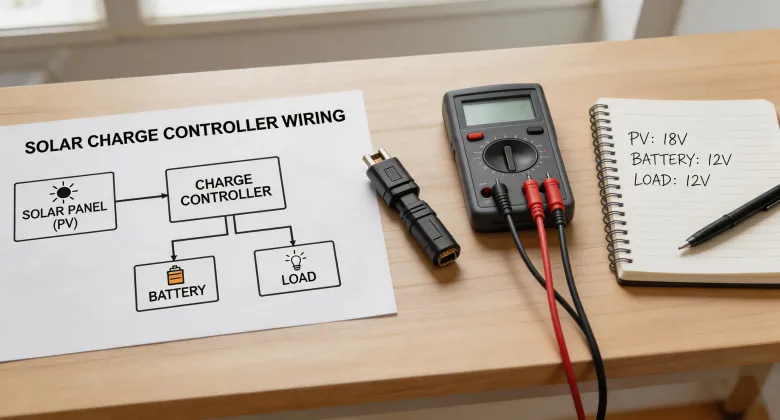
Last October, a warranty box arrived on my bench with the kind of note that makes a quality person stop and read it twice:
“Controller failed. Customer without power for three days. Please warranty.”
It was a Morningstar TriStar MPPT 60, pulled from a 6.2 kW solar battery storage job in Seguin, Texas. I run quality and compliance reviews at Morningstar, and roughly 200 returned units cross my desk every year. In four years of doing this, I’ve learned that most field-failed controllers tell a clear story: burned terminals, swollen capacitors, visible trauma. This one looked almost new.
That made me suspicious for the opposite reason. A clean controller with an angry warranty claim usually means the problem was never the controller.
A No-Fault Return, But Nobody Was Lying
The first bench test came back clean. No shorted FETs. No cracked solder joints. The unit powered up, slewed correctly, held regulation, and produced the expected charging waveform. By the numbers, the controller was fine.
I was ready to reject the return when I remembered something the installer had mentioned: he’d set up remote monitoring on the site. He was using the Morningstar Portal login app, which meant we had access to charge current, battery voltage, and fault history from the unit itself. So I logged in and pulled the logs.
That’s when the story changed.
On every clear day for the previous three months, the charge current graph flat-lined at 60.0 A—exactly the controller’s maximum output rating—from mid-morning until late afternoon. There were no fault codes. The unit wasn’t struggling. It was doing precisely what a 60 A Morningstar charge controller is designed to do.
The problem was that it had been doing that for months, and it still wasn’t keeping the customer’s battery bank charged.
I don’t have hard data on how many undersized off-grid systems are out there. But based on the returns I’ve reviewed over the last four years, my sense is that amp-sizing mismatches are involved in a meaningful share of “no fault found” warranty claims. Not because the hardware is weak. Because the hardware was never matched to the actual load.
Everybody Asks ‘How Many Amp Solar Controller Do I Need?’ Backward
The installer told me his original question had been a Google search verbatim: “how many amp solar controller do I need?” He’d looked at the 6.2 kW array, looked at a 60 A charge controller, and assumed the controller’s amp rating described the array side of the system.
It doesn’t.
On a Morningstar MPPT charge controller—and on most MPPT controllers—the amp number in the model name is the output charge current rating. That is, the maximum current the controller can push into the battery at the system voltage. It is not the same as the array’s short-circuit current, and it is not a direct measure of how many solar panels you can connect.
The useful way to think about it is energy first, amps second.
A 6.2 kW array in Seguin produces more than 6.2 kW of DC power at STC, but real-world conditions rarely reach STC. Assume derating for module temperature, soiling, and MPPT conversion losses, and a healthy system might deliver somewhere around 80 percent of that figure. That’s roughly 5 kW into the controller. On a 48 V battery bus at absorb voltage near 55–56 V, that's:
5,000 W ÷ 55 V ≈ 91 A of charge current required.
A 60 A controller simply cannot pass that much current. It wasn’t broken. It was under-specified for the solar array attached to it.
The fix wasn’t a repair. It was a 100 A controller—or splitting the array across two 60 A controllers. Physically, the array and battery were fine. The architecture was the defect.
What the kWh Solar Panel Calculator Should Have Caught
I ran the design through a kWh solar panel calculator based on NREL’s public irradiance data for the Seguin area. In a good month, that array could harvest 30 kWh or more of solar energy per day. With the 60 A controller limiting charge to roughly 3.3 kW per hour, the system would cap out around 19–20 kWh on the best days. On cloudy Texas winter days, the difference was even worse relative to the customer’s daily draw.
The kWh number matters more than the amp number because batteries are energy devices. A customer with a 30 kWh battery bank doesn't care what the peak charge current is. They care whether the bank is full before the next storm front moves in.
For any solar battery storage system, the basic order should be:
First, calculate the daily load in kWh. Second, estimate usable solar production from the array with a proper calculator that accounts for location, tilt, and seasonal irradiance. Third, divide that average power by the battery voltage to get the charge current the controller should be rated for. And finally, add margin so the controller isn’t running at its maximum rating for six hours a day, every day.
It sounds obvious now. But in practice, I see systems where the charge controller was chosen because it was the same amp rating as the inverter’s AC output, or because a forum post said “60 amp is fine for most houses,” or because the supplier needed to hit a price point.
The Real Cost Wasn’t the Hardware
The customer in Seguin is not an unusual case. They paid for a solar battery storage system that promised energy independence. What they got was a well-built set of components that were mathematically never going to deliver it.
Here’s the part I care about as a quality person: the installer’s quote was lower because it included a 60 A controller. The more honest quote would have been higher—either for a bigger controller or for a smaller array that matched the controller correctly. That’s not a pleasant conversation to have with a customer. But it’s far cheaper than the conversation that happens after the battery dips below 20 percent on the third cloudy day.
I’m a strong believer in transparent pricing and transparent specs. When a supplier quotes undersized equipment to win the order, the hidden cost shows up later as a service call, a callback, or a social media complaint. The inverter and battery get blamed. The controller gets blamed. Nobody blames the sizing math.
The vendor who lists all the relevant numbers upfront—even when the total looks higher—usually costs less in the end. That’s as true for charge controllers as it is for any other component in a renewable energy system.
What We Changed Internally
We didn’t change the warranty policy because of this case. The controller wasn’t defective, and I’d make the same call again today.
What we did change was our guidance document. It now opens with the sizing question reversed: start with the battery voltage, start with the daily kWh load. The old document listed maximum ratings. The new one shows what those ratings actually mean in a working system.
I wish I had tracked how many installers received those updated docs. What I can say anecdotally is that three other Seguin-area systems have come through our monitoring portal since then, and none of them are running a 60 A controller against a 6 kW array.
There is something satisfying about those graphs, honestly. After months of seeing charge current pin itself to the ceiling, the new logs show a system that works the way the customer expected it to work. The controller isn’t the hero. It’s just finally the right size.