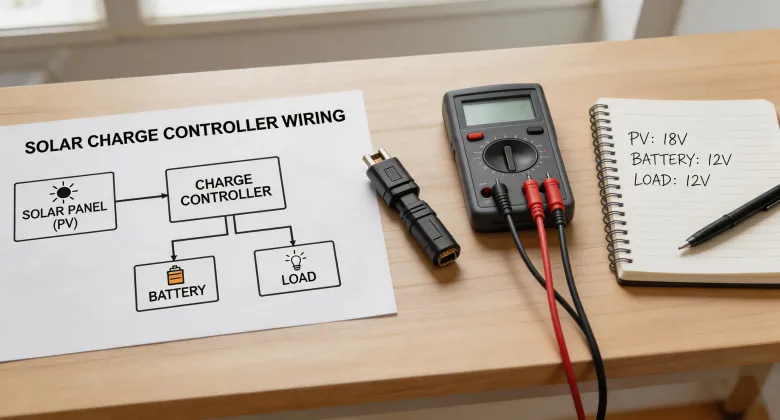
I'm a procurement manager at a 45-person solar integration company. I've managed our off-grid component budget—about $380,000 annually—for seven years. We've standardized on Morningstar charge controllers across roughly 900 remote sites, but I don't think there's one right Morningstar configuration for everyone. If you're comparing Morningstar products, the answer depends on your project type, your maintenance model, and how you define cost.
Here's the thing: most buyers ask for a controller first. That's backwards. The controller sits between the array and the battery. What sits after the battery—inverter, AC loads, monitoring—often determines whether the Morningstar unit you pick actually saves money. So before you open the Morningstar store, classify your project into one of three scenarios.
Scenario A: Small off-grid systems with a solar panel with AC outlet
This is the most common request we get from installers. A customer wants a solar panel with AC outlet—sometimes a single panel, sometimes a small array—to run tools, lights, or a fridge. The phrase sounds simple. It isn't.
What does a solar power inverter do? It converts DC power from the battery into AC power for those outlets. But the inverter doesn't charge the battery. That's the charge controller's job. If you skip a quality MPPT controller, you can lose 10-30% of your array's harvest depending on temperature and voltage mismatch. That loss shows up as more panels or shorter runtime—not as a line item on the spec sheet.
For this scenario, I'd look at Morningstar MPPT controllers sized for the array's maximum input voltage and the battery bank's charge profile. Pair them with a pure sine wave inverter, not a modified sine wave unit, unless your loads are resistive only. I should add that 'AC outlet' often means different things to different people. I said 'AC outlet' to a supplier once. They heard 'modified sine wave inverter.' Result: we shipped a kit that couldn't run a variable-speed tool, and we ate a $600 restocking fee. Now we confirm continuous wattage, surge rating, and waveform in writing before ordering.
This approach worked for us, but our sites were in temperate climates with four to five peak sun hours. If you're in high-latitude or heavy dust conditions, the calculus might be different.
Scenario B: Solar panel drone inspection and remote monitoring
If you're managing more than a handful of sites, solar panel drone inspection becomes a cost-control tool. Drones find hot spots, cracked cells, and soiling fast. But a drone image doesn't tell you whether the problem is the panel, the wiring, or the charge controller. That's where Morningstar's remote monitoring comes in.
We use Morningstar Portal to pull daily kWh, battery voltage, and fault logs. When a drone inspection flags a hot spot, we cross-check the controller data. If the array current is normal but the image shows heat, we may have a panel issue. If the controller is logging low input voltage, we may have a wiring or shading problem. The two data sets together cut truck rolls.
Don't buy monitoring as an afterthought. Morningstar products with built-in networking or add-on modules cost more upfront. But if a single site visit costs $450 in labor and travel, two avoided visits pay for the hardware. That's the TCO math that matters. Verify current Morningstar store compatibility and firmware requirements before you standardize—firmware changes more often than hardware.
Here's a boundary: I can only speak to our own maintenance workflow. If your drones are operated by a third party and you don't control the inspection schedule, the integration may not be as smooth.
Scenario C: Critical remote systems where downtime is the real cost
For telecom, security, or navigation sites, the battery bank and controller are not commodity items. This is where I'd spend more per unit and less on replacement labor. Morningstar TriStar MPPT controllers have a long track record in these applications. We run them with temperature-compensated charging and redundant monitoring where the site is hard to reach.
The counterintuitive part: the cheapest controller is often the most expensive decision. A lower-efficiency MPPT can force you to add a panel or a battery to cover losses. On a $12,000 remote power system, a 5% harvest difference can mean $600 in extra array cost—plus mounting, wiring, and labor. That's before you count downtime.
Per FTC advertising guidelines (ftc.gov), claims about solar equipment performance must be truthful and substantiated. If a product listing says 'solar panel with AC outlet' but doesn't specify inverter type, continuous wattage, and surge rating, treat it as incomplete. Under the FTC Green Guides (16 CFR Part 260), environmental claims like 'clean' or 'renewable' should also be backed by evidence. Ask for the datasheet, not the marketing sentence.
How to tell which scenario you're in
Ask four questions before you buy from the Morningstar store or any distributor:
- Do you have AC loads? If yes, you need an inverter—and you need to understand what a solar power inverter does relative to the charge controller.
- Will you inspect and maintain more than five sites? If yes, remote monitoring and solar panel drone inspection data should be part of the purchase, not a later add-on.
- What does one day of downtime cost? If it's more than the controller's price, you're in Scenario C.
- Can you verify the exact model, firmware, and warranty terms? If the answer is no, you're not ready to order.
I'd rather spend ten minutes explaining these trade-offs than deal with a mismatched expectation six months later. An informed customer asks better questions and makes faster decisions. That's better for you, and honestly, it's better for us.
Prices and availability change; verify current Morningstar product specs and Morningstar store pricing before you commit. This worked for our projects, but your sites, loads, and maintenance model will decide the final configuration.