Let me start with an opinion that won't make me popular in every design review: most solar charge controller failures I've dealt with were preventable. Not because the equipment was bad. Not because the installers were careless. Because someone skipped a five-minute check at the procurement stage. After six years of buying components for off-grid solar systems, I've learned that prevention is cheaper than correction. Always.
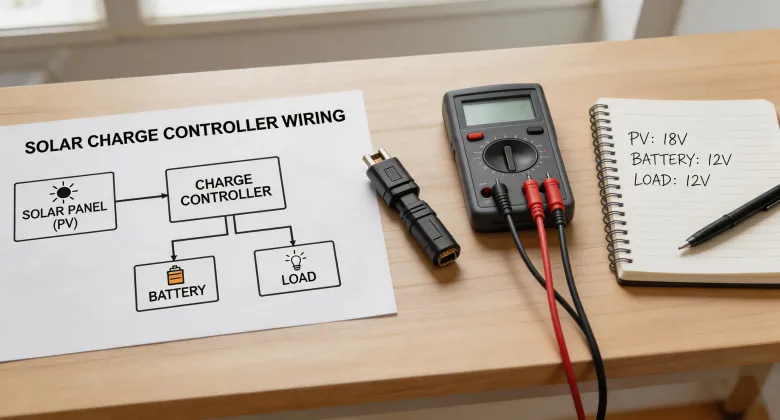
If you're new to this side of the industry, here's a quick solar charge controller definition: it's the device between the solar array and the battery bank that regulates voltage and current. It stops overcharging, it stops reverse current at night, and in many systems it manages connected loads. In plain language, it keeps the battery from being cooked while the sun is up.
That sounds basic. But I've seen project quotes where the controller was chosen after everything else, based on the idea that 'it's got MPPT, so it should work.' That's how failures start. If you want an authoritative starting point, the National Electrical Code's Article 690 and IEEE 1562, the guide for sizing stand-alone PV systems, both treat charge control as a core safety function. The controller is not an accessory. It's what connects the array's voltage to the battery's limits.
The First Time I Saw the Difference
In 2023, I compared two quotes for a remote telecom site. Both controllers claimed 40A. One had a maximum PV input voltage around 150V. The other sat at 100V. The arrays were identical. The price difference was only $220. I was ready to pick the cheaper one until I did the math on the coldest morning of the year—array voltage comes up when temperatures drop, and the cheap unit was running dangerously close to its ceiling. When I compared the two quotes side by side, I finally understood why 'same amp rating' doesn't mean 'same controller.'
That $220 was not an expense. It was insurance. The cheap option could have failed within months, taken a battery string with it, and turned a repair into a project delay. (Surprise, surprise.)
Prevention Is a Process, Not a Promise
One of the most expensive mistakes I've made was not having a formal spec-verification checklist. We didn't have a process that forced us to match the controller's maximum input voltage to the array configuration before ordering. Cost us when a batch of controllers arrived with the wrong load termination settings, and we didn't catch it until commissioning. That was a field rework, a follow-up truck roll, and a very patient customer. The root cause wasn't the controller. It was the process.
Now I run every order against a short list. It's boring, but boring is cheap:
- PV input voltage: at least 20% headroom above the coldest estimated Voc.
- Charge current: match the battery bank's accepted current, not just the panel wattage.
- Battery chemistry settings: programmable or switchable for the actual battery type.
- Temperature sensor: included, not a 'nice to have' extra.
- Monitoring: a communication port or app integration, so you can see what's happening after you leave.
That last item is a deal-breaker for me now. Honestly, I still don't fully understand why some installers treat monitoring as an optional feature. My best guess is that it looks like extra commissioning time. But remote visibility is what catches a problem before it becomes a failure. The Morningstar app, for example, lets me check charging voltage and battery state from my desk, which is a lot better than driving four hours to a site to find out why a warning light is on. If you haven't used it, the Morningstar official website has the compatibility list and manuals. Start there.
Let's Talk About Solar Hybrid Inverters with Battery
Every few months, someone asks why we're 'still' buying external charge controllers when a solar hybrid inverter with battery can handle the whole system. And sometimes it can. A solar hybrid inverter with battery is a legitimate product class, and I've seen it work well on small AC-coupled systems. But I've also seen the hidden costs.
Here's the pattern: someone chooses an all-in-one unit because it promises fewer components. Then the PV array is configured to squeeze the highest possible voltage into that inverter's MPPT range. The external charge controller disappears from the design. The inverter becomes the only line of defense. On a mild day, fine. On a cold, bright winter day, the array voltage spikes, the inverter does something smart to protect itself, and the battery charge current drops. The system still runs. But the battery never fully charges. The customer sees lower storage, and nobody connects it back to the missing headroom in the controller design. (Which, honestly, is the whole point of prevention—an invisible problem is still a problem.)
That's not an argument against hybrid inverters. It's an argument for checking the architecture before you buy, instead of after the first winter.
The 'Solar System vs Galaxy vs Universe' Scope Check
One of our senior technicians made a joke during a design review that stuck with me: 'Solar system vs galaxy vs universe—are we quoting the panel, the whole energy ecosystem, or the entire grid?' It sounded like a pun, but it's a real scope problem.
When someone says 'solar system,' they might mean just the PV array. Or the array plus battery. Or the entire off-grid platform with monitoring, distribution, and backup. If you don't clarify that upfront, you'll order components with the right intentions and the wrong specifications. I've had a client ask for a 'complete solar system' and then push back on the charge controller because they thought it was an add-on. It wasn't. It was the safety gate for the battery bank.
So yes, spend a minute on the vocabulary. A charge controller is not optional. A solar hybrid inverter with battery does not automatically eliminate it. And a 'solar system' can mean very different things depending on who's talking. Define the universe before you price the planet.
Objections I Hear in Meetings
'Checking specs slows us down.' I hear that one often. But in my experience, the opposite is true. Five minutes of verification beats five days of correction. If a quote doesn't match the design, waiting until commissioning to find out is expensive. Now, I'm not saying every controller needs to be oversized into absurdity. I'm saying the numbers need to match the actual conditions.
5 minutes of verification beats 5 days of correction.
'We don't need a checklist; our senior engineers know this.' Maybe. But the senior engineer isn't in the room when the purchase order is issued. The process is there to make the right decision the default decision, even when the smartest person in the room is on vacation. That's not bureaucracy. That's cost control.
'We can always add monitoring later.' You can. It just costs more, and sometimes 'later' is after a battery failure. I've never once said 'I'm so glad we skipped monitoring on that site.' (I have said the opposite, more than once.)
Bottom Line
I don't think every off-grid system needs the most expensive controller on the market. But it needs a controller that is actually designed for the array and the battery. That means verifying the datasheet, checking the temperature limits, and setting up a way to see if the system is doing its job.
The Morningstar official website is a good place to start when you're comparing options. The Morningstar app is a good tool to keep once the system is running. And if you take nothing else from this article, take this: the cheapest controller is the one you check before it fails, not the one you replace after it causes a bigger problem.
Prevention isn't a punishment. It's the best budget line item I've ever managed.