-
What is a Morningstar charge controller?
-
What is the Morningstar TriStar MPPT?
-
Should I choose a Morningstar controller or a hybrid solar inverter 5kW with built-in MPPT?
-
What's the catch with cheaper charge controllers and inverters?
-
What is a portable solar generator?
-
What do 'solar system colouring pages' have to do with professional solar design?
-
Is a Morningstar charge controller compatible with any panel or inverter?
-
What's the fastest way to replace a dead controller in an emergency?
I coordinate off-grid power equipment for solar installers, and since 2014 I've helped with 200+ rush orders—same-week replacements, failed charge controllers, and the occasional 'we need this before the inspection.' This FAQ is built from field notes, not marketing bullet points.
The question I get most isn't 'which Morningstar charge controller is best?' It's 'which one can I get before the client's site loses power again?' Let's start there.
What is a Morningstar charge controller?
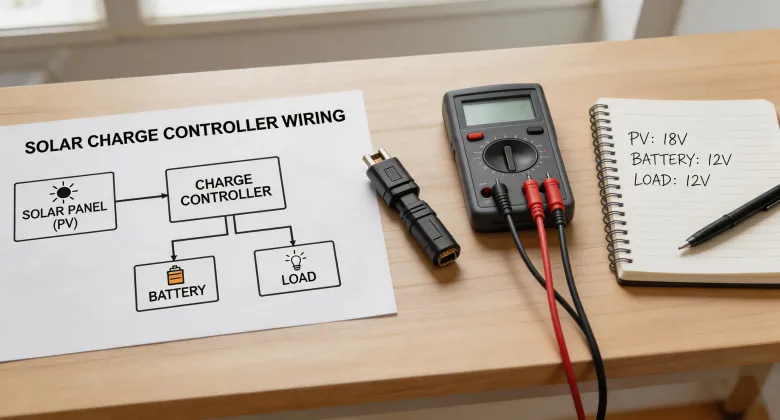
A Morningstar charge controller sits between the solar panels and the battery bank. It regulates voltage and current so the batteries don't get overcharged. Put another way: it's the traffic cop between your array and your batteries. No controller means overvoltage, reduced battery life, and eventually a dead site.
Morningstar makes a range of controllers, from the small SunSaver to the ProStar and TriStar families. The MPPT versions use active maximum power point tracking to pull more usable power from the same panel. Why does this matter? Because in off-grid power, the controller isn't the part anyone praises—until it stops working. Then it's the only part that matters.
What is the Morningstar TriStar MPPT?
The TriStar MPPT is Morningstar's high-current MPPT controller family. It's designed for larger arrays and 12V, 24V, or 48V battery banks, and it gives you data logging and remote monitoring. If a site is a long truck roll away, the Morningstar Portal can save the cost of a service visit.
According to Morningstar's product documentation (morningstarcorp.com), each TriStar MPPT model has a maximum PV input voltage. Exceeding it can void the warranty and, worse, send voltage where it shouldn't go. I want to say the TriStar MPPT line covers a wide range, but the exact current tables change with each revision—check the datasheet.
Should I choose a Morningstar controller or a hybrid solar inverter 5kW with built-in MPPT?
A hybrid solar inverter 5kW is an all-in-one box: MPPT charge controller, inverter, and battery connection in one unit. A Morningstar charge controller is a standalone DC charger that feeds the battery, while an inverter pulls DC power out of the battery. Both can be part of the same system, but they're not interchangeable.
If you're building a simple backup system, the hybrid inverter's built-in MPPT might be enough. If you have a larger DC-coupled array, remote monitoring requirements, or a battery bank that needs robust charging, a standalone controller makes sense. Three things to check: battery voltage, PV input voltage, and charge current. In that order.
A word of caution: don't run two charge controllers on the same battery bank unless both manuals say they can share. 'It should be fine' is how you ruin a battery bank.
What's the catch with cheaper charge controllers and inverters?
Let me rephrase the question: what isn't included? A low quote can leave out the programming cable, the remote meter, overcurrent protection, and a return policy that actually works. The vendor who lists all fees upfront—even if the total looks higher—usually costs less in the end.
I've learned to ask what's NOT included before 'what's the price?' Once, a client picked a cheaper controller based on the base cost. The hidden add-ons pushed it past a Morningstar TriStar MPPT. We didn't have the spare in stock, either, so the outage lasted longer. (Should mention: that was 2023, and it's when we started stocking common SKUs.)
Honestly, I'm not sure why some vendors quote in stages. My best guess is their quoting tools are designed for sales, not for total project cost. Either way, transparent pricing is cheaper in the long run.
What is a portable solar generator?
A portable solar generator is a battery, charge controller, and inverter in one case. Solar panels plug into it, and AC and DC outputs come out. It's useful for mobile crews, emergency backup, and temporary sites. It's not a substitute for a permanent off-grid system when you need reliable power for years.
Can you use a Morningstar charge controller with a portable solar generator? Usually no, because the units are sealed. Some higher-end units expose DC terminals, and that's where an external controller could be added. If the internal charger stays active, you have the two-charge-sources problem again. And 'works with most portable generators' is a red flag, not a spec.
What do 'solar system colouring pages' have to do with professional solar design?
Technically, nothing. But a colouring page is a diagram, and a diagram catches mistakes before they are expensive. The systems that fail in the field are rarely the ones that were carefully drawn first. The expensive ones are the ones where someone skipped the one-line diagram and ordered from a spreadsheet.
If you're explaining solar to a client, a simplified drawing shows the flow: panel to charge controller to battery to inverter. It also shows what's missing—disconnects, fuses, grounds. Under NEC 690, PV systems need correctly sized overcurrent protection. A charge controller is not a substitute.
Draw the system twice: once as a beginner sketch, once for the inspector. That's the closest thing to free insurance in this industry.
Is a Morningstar charge controller compatible with any panel or inverter?
No. Anyone who sells 'universal compatibility' is selling a story, not a technical spec. Per FTC guidelines (ftc.gov), those claims need substantiation. In reality, you match three numbers: panel voltage vs controller max PV input, battery voltage, and the inverter's charge profile if it also charges the same bank.
This 'one controller works with everything' idea comes from an era when systems were simpler. Today, compatibility is a math problem. Can a Morningstar TriStar MPPT share a battery bank with a hybrid solar inverter 5kW? It can, if the inverter's charger is disabled or the two charge sources are configured to cooperate. Check the inverter manual before you connect them.
What's the fastest way to replace a dead controller in an emergency?
This is where I live. In my role coordinating off-grid equipment, I've processed 200+ rush orders since 2014. Last quarter alone, we handled 47 rush jobs with 95% on-time delivery—not perfect, but strong.
The fastest fix isn't overnight shipping. It's this:
- Confirm the real failure. Check batteries and wiring before blaming the controller.
- Confirm the exact model and settings from the failed unit.
- Check stock before promising anything.
- Pay for tracking and signature confirmation.
- Tell the client the total cost, including the expedite fee.
In March 2024, a client called at 4 PM with a dead TriStar MPPT at a remote telecom site. Normal ground shipping was five days. We overnighted a replacement for, I want to say, $180 in rush freight—don't quote me on the exact number—and had it online in 26 hours. The client's alternative was a week-long site outage.
Since then, we stock the three most common Morningstar SKUs. That one policy cut our emergency turnaround from days to hours. 'We don't have to wait for a quote' is the best thing a supplier can say.