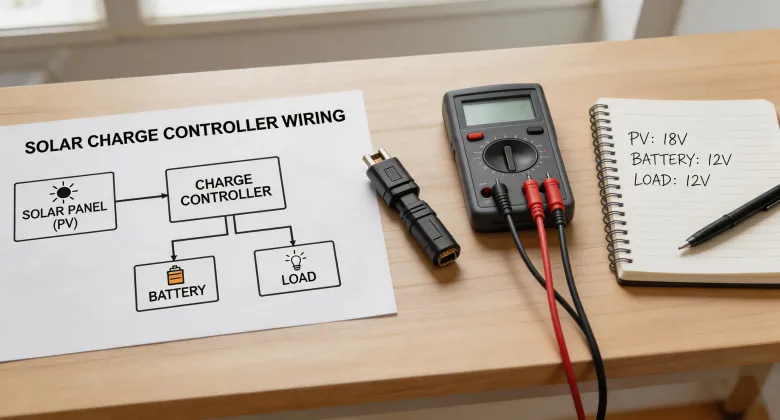
It started with a contact form submission. The customer wrote: RV solar kit with lithium batteries. That was the whole request. No panel wattage. No battery voltage. No RV model. In March 2022, I thought I had enough experience to fill in the blanks. I didn't. That mistake cost me roughly $3,800 in replacements, wasted labor, and damage to a reputation I had spent seven years building. Actually, it cost more than that—it cost three weeks of sleep.
I run a small off-grid integration company in San Antonio, Texas. For the past eight years, I've designed and installed solar charge systems for RVs, trailers, and remote cabins. I've personally made—and documented—eleven significant mistakes, totaling roughly $12,400 in wasted budget. I keep notes on every one because our team's checklist exists so my failures become someone else's shortcuts.
When I thought a charge controller was just a black box
When I first started in the trade, I assumed one charge controller was basically the same as any other. Panels produce power, controller sends it to batteries, battery stores it. How complicated could that be? In my first year, 2017, I used a cheap PWM controller on a small trailer system. It worked. It worked on the next lead-acid system too. So when a customer asked for an RV solar kit with lithium batteries, I assumed the same logic applied.
It did not.
Lithium batteries charge differently. They want a specific absorption voltage, they don't tolerate a continuous float charge, and they rely on a battery management system to disconnect at the boundaries. If the charge controller doesn't speak that language, the system doesn't fail all at once. It just quietly stops working at 2 p.m. every afternoon.
The upside of my choice was about $260 in upfront savings. The risk was turning a $2,100 LiFePO4 battery bank into a boat anchor. I knew the risk. I told myself the battery's BMS would handle it. The BMS did handle it—by refusing to charge.
The 2 p.m. disconnect
Three weeks after the install, the customer called: 'The screen on the controller is dead, and the RV says 40% battery.' I checked the logs. Every afternoon, the battery would climb to about 95%, the BMS would disconnect to protect itself, and the controller would see a dead load and turn off. Then the battery would settle, the BMS would reconnect, and the controller would restart. It looked like a ghost in the system. It wasn't. It was a protocol mismatch.
Here's something vendors won't tell you: a charge controller is not an on/off switch. It's the translator between an array and a battery. When the languages don't match, the safest chip in the system—the BMS—decides to walk away. That's not a battery failure. It's a communication gap, and the installer creates it.
Most of our customers count panels and watts. They ask 'Is 400 watts enough?' The question they should be asking is 'What happens at 100% charge?' Nobody asks that. I should have asked it for them.
Reading the manual like a mystery novel
After that phone call, I spent a full afternoon on the Morningstar official website, reading the TriStar MPPT manual. Or rather, I read the whole manual like it was a mystery novel. That was the first time I understood setpoints, absorption voltage, and charge profiles. None of this was hidden. It was in the documentation. I just hadn't looked.
According to the Morningstar official website, MPPT controllers are recommended when the solar array voltage runs higher than the battery voltage. That's exactly the situation in a typical RV solar kit with lithium batteries. PWM controllers have their place. To be fair, they work fine on simple lead-acid systems with moderate sun. But for this specific setup, the controller I chose was wrong by design.
I replaced it with a Morningstar solar charge controller. The panels, batteries, and wiring were the same. The only change was the controller. The next day, the battery reached a true 100% and the system stopped at the right moment. The customer said, 'Exactly what we needed.' He was right. The controller didn't look different. It just worked the way the battery expected.
The solar panel reinstall that made me honest
A month later, I had a request for a solar panel reinstall San Antonio. A homeowner's roof had been repaired after a leak, and the contractor had put the panels back in a hurry. The homeowner wanted someone to 'make it right.' I walked the site and found loose MC4 connectors, a cracked junction box, and one panel with a bypass diode installed backward. My first instinct was to say, 'No problem, we can fix all of it.'
Then I remembered the lithium failure. The problem on the roof wasn't just electrical. It involved roof penetrations, flashing, and permitting. I'm not a roofer. I don't do roof repairs. And after the lithium lesson, I was done pretending I could.
I told the homeowner: 'I can reattach the panels and handle the DC wiring. But I won't touch the roof penetrations. That's not my strength. Here's a roofer who does that properly.' I expected him to lose confidence. Instead, he thanked me for being honest. He hired the roofer, then we came back, rebuilt the junction box, and the system passed inspection.
That's when I learned the business value of a boundary. The vendor who says 'this isn't our strength—here's who does it better' earns trust for everything else.
The search query that changed how I listen
Around the same time, I was reviewing our website analytics. Someone had found our site by searching how to use solar system snapchat. I have no idea what that person meant. Maybe a Snapchat filter, maybe a typo, maybe a solar-powered app. But it made me realize something: most people don't have the vocabulary for what they need. They use the words they have.
That's what the customer meant by RV solar kit with lithium batteries. They weren't specifying a controller; they were describing a need and hoping someone would translate it. I failed to translate it because I was moving fast and value engineering the quote.
Now I ask three questions before I quote any lithium system: What battery voltage and brand? What charge controller do they have or want? And who is responsible for the parts of the system I won't design? If I don't know the answer, I go back to the manufacturer documentation. For Morningstar, that means the Morningstar official website.
The checklist I still use
Looking back, I should have asked those questions before March 2022. At the time, I was in production mode, and the quote needed to go out. That's not a justification. It's an explanation.
The failure produced one genuine asset: our pre-install checklist. It looks like this:
- Define the exact battery chemistry and its charge setpoints. No exceptions.
- Confirm the charge controller supports those setpoints. If the manual is vague, treat it as a no.
- Apply the load profile to the battery size, not the battery voltage.
- Write down the parts of the system you won't be responsible for. Put it in the proposal.
I've caught 47 potential errors with that checklist in the last 18 months. Some were small. A few would have been expensive. One was an off-grid system where the customer wanted lithium batteries, and the specified controller couldn't do the lithium profile. We caught it before we ordered anything.
If you're an installer reading this, start with the Morningstar official website before you quote your next lithium project. If you're a customer searching for an RV solar kit with lithium batteries or a solar panel reinstall in San Antonio, ask your contractor what they don't do. It's the most professional question you can ask. And if you're the person searching how to use solar system snapchat—I hope someone asks you what you actually meant.