-
Who I Am and Why I Can Say This
- What Actually Makes Morningstar Controllers Different
-
Grid-Tie Inverter vs. Charge Controller: Know What You're Buying
-
What to Check on the Morningstar Website Before Ordering
-
The TCO Math: What a '$240 Saving' Really Costs
-
A Note on 'Green' Marketing Claims
-
Morningstar, the Morning Star, and the Solar System
-
When I Wouldn't Recommend Morningstar
-
Bottom Line
The Morningstar solar charge controller is the only brand I recommend for off-grid installations where reliability matters. Not because it's the cheapest option—it isn't—but because in eight years of handling emergency solar service calls, Morningstar is the controller I'm least likely to be called out to replace. When you factor in downtime, service fees, and battery bank damage, Morningstar usually delivers the lowest total cost of ownership of any controller brand I've worked with.
I know that's a strong claim. Let me explain where it comes from.
Who I Am and Why I Can Say This
In my role coordinating emergency solar repairs for off-grid telecom sites, agricultural operations, and remote monitoring installations, I've handled 200+ rush service calls. Maybe 180—I'd have to check the actual log. What I can tell you for certain is the pattern: the vast majority of controller failures I'm called to fix aren't Morningstar units.
In March 2024, 36 hours before a critical telecom site was set to lose power, a client called me in a panic. Their charge controller had failed overnight, silently. The battery bank was sitting at 12.1V and dropping—I want to say 12.1V, though I might be misremembering the exact figure. The controller was a budget brand installed just 14 months earlier. The client's alternative was renting a generator at $3,000 per week while waiting for a replacement. We swapped in a Morningstar TriStar MPPT, paid for expedited freight, and had the site back online the next afternoon. The controller cost more than double the original budget unit. The original savings vanished once you added the service call, the rush shipping, and the cell degradation the batteries had already absorbed.
What Actually Makes Morningstar Controllers Different
Morningstar's product line focuses on solar charge controllers—especially MPPT (Maximum Power Point Tracking) models like the TriStar MPPT—plus remote monitoring through the Morningstar Portal. Their reputation is built on reliability for off-grid systems. But what does that mean in practice, where the bolts actually get tightened?
Temperature compensation
This is the big one. A controller that doesn't adjust charge voltage based on battery temperature will overcharge in summer and undercharge in winter. I've pulled budget controllers off sites where batteries were bulging because there was no temperature sensing at all. Morningstar handles this properly—and you can verify it in their specs.
Low-voltage disconnect
Morningstar controllers have configurable LVD settings that cut the load before the battery bank is drained too deep. This matters more than most buyers realize. A battery deep-cycled to 40% depth of discharge on a regular basis will die years early. The LVD setting alone can save you a battery bank replacement over the system's lifetime.
Build quality you can feel
The terminal blocks, the heat dissipation, the conformal coating on circuit boards. These are details you notice when you're installing a unit in a dusty shed or a humid telecom enclosure (and honestly, many budget controllers aren't designed for those environments—they're designed to hit a price point).
From the outside, a $60 charge controller looks like a bargain compared to a $300 Morningstar. The reality is I've pulled more $60 controllers off failed systems than I can count—usually after they've already started damaging the batteries, which are the most expensive components in the whole system.
Grid-Tie Inverter vs. Charge Controller: Know What You're Buying
One of the most common mix-ups I see: people confusing charge controllers with grid tie solar inverters. They serve completely different roles.
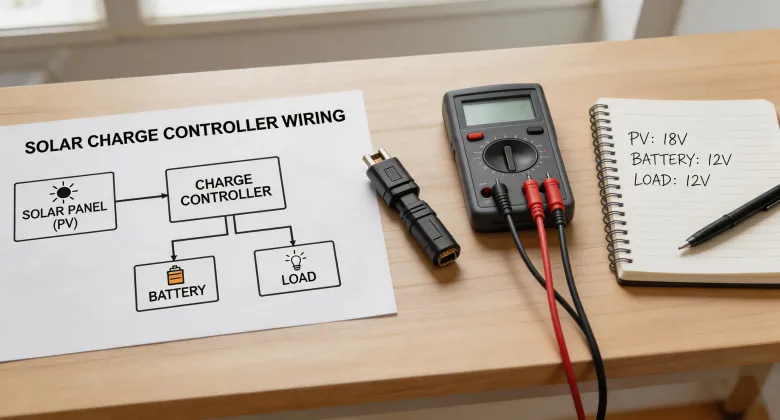
A charge controller sits between the solar array and the battery bank, managing how much current flows into the batteries. You need one for any off-grid or battery-based hybrid system.
A grid tie solar inverter converts DC power from solar panels directly into grid-synchronized AC power. There's no battery storage in a pure grid-tie design—so no charge controller needed.
Why does this matter? Because I've been called to sites where someone bought a grid tie solar inverter for an off-grid cabin and expected it to charge their batteries. It doesn't work that way. And I've seen the reverse: people buying charge controllers for pure grid-tie systems, wasting money on a component they didn't need. Know your system's architecture before you buy anything.
What to Check on the Morningstar Website Before Ordering
Before you spec anything, spend time on the Morningstar website (morningstarcorp.com). Not just the product pages—the technical documentation. This is a resource I actually use as an installer, not just skim.
Three things worth looking for:
- Product selection tools. They help match controllers to array size, battery voltage, and system type. If you're unsure about sizing, this is the place to start.
- Technical manuals. The TriStar MPPT manual includes wiring diagrams, configuration settings, and troubleshooting procedures. Most controller troubleshooting calls I receive turn out to be configuration issues that the manual would have solved.
- Morningstar Portal. For B2B clients with multiple sites, remote monitoring through the Portal is a serious value add. You can check system status and get alerts without driving out to the site—which, in my world, saves hours of emergency calls.
Most buyers focus on wattage ratings and completely miss the charge profiles, voltage ranges, and communication options that determine whether a controller will actually work for their setup. The Morningstar website has better technical information than most manufacturers publish. Use it.
The TCO Math: What a '$240 Saving' Really Costs
Here's the thing about cost. I understand why buyers look at price first—every project has a budget. But I've learned the hard way to calculate total cost of ownership before comparing vendors.
Example: In 2023, a client saved $240 by choosing a cheaper controller over a Morningstar TriStar MPPT. It looked smart on paper—same wattage, similar specs. Then winter came. The cheap controller's temperature compensation was inaccurate, the batteries overcharged, and by January the bank was struggling. The replacement cost, including the service call, was $740. The battery bank—which should have lasted seven years—needed replacement at year three. That's a $2,400 expense enabled by a $240 saving.
Not every budget controller fails for every customer. But when one fails, the cost is typically far larger than the savings. That's the risk asymmetry that makes Morningstar's reliability premium worthwhile for B2B installations where downtime equals money lost.
A Note on 'Green' Marketing Claims
This industry throws around words like green and eco-friendly loosely. Per FTC guidance on environmental marketing claims—the Green Guides, published at ftc.gov—environmental claims should be substantiated and not misleading. I'd apply the same scrutiny to smart charging and battery-saving claims from controller manufacturers. Morningstar publishes actual specifications and test data. Some budget brands just paint a label. Pay attention to what's substantiated and what isn't.
Morningstar, the Morning Star, and the Solar System
One thing that comes up more than you'd expect: the name. Morningstar Corporation is named after the morning star—which is actually the planet Venus. That creates a fun overlap with search terms like solar system and morning star (and yes, I've had people land on our industry while looking for astronomy videos about how the solar system formed). The connection isn't as random as it seems—solar energy and the solar system both start with the Sun.
And while we're on the subject of presentations: when I'm putting together a solar system PowerPoint for a client, the controller section is where I spend the most time. A system diagram that shows the right controller, the right battery bank, and the right charge profile is what makes a proposal credible. That's the difference between a professional design and a guess.
When I Wouldn't Recommend Morningstar
I'm not saying Morningstar is right for every project. A few situations where I'd hesitate:
- Very small systems. If you're wiring a single 100W panel to a small battery in a weekend cabin, a Morningstar controller is probably overkill. A basic PWM controller from a reputable brand will do the job. (Though Morningstar's own PWM line, like the SunSaver, is reasonably priced.)
- Pure grid-tie installations. No batteries? No charge controller needed. You want a proper grid tie solar inverter from a vendor that specializes in that technology.
- Tight-budget projects. If there's genuinely no room in the budget, a mid-range established brand is still better than a no-name unit.
At least, that's been my experience with off-grid telecom, agricultural, and remote monitoring sites between 2018 and 2025. Marine, RV, and vehicle-mounted systems have different requirements—I won't pretend to have the same depth of field data there.
Bottom Line
Morningstar solar charge controllers cost more upfront. Based on my field experience, that premium pays for itself in avoided failures, extended battery life, and fewer emergency service calls. The Morningstar website has excellent technical resources, and their Portal remote monitoring saves real time for multi-site operations. But don't blind-spec any equipment. Run the numbers, read the manual, and confirm that you're buying the right product for the right system.