-
What We're Actually Comparing
- Dimension 1: Total Cost of Ownership (TCO) — Not Just the Sticker Price
-
Dimension 2: Flexibility — Can I Add Batteries Later?
-
Dimension 3: Performance — MPPT Efficiency Matters More Than You Think
-
Dimension 4: Reliability — The Hidden Cost of 'Cheap'
-
When an All-in-One Makes Sense (Honest Limitation)
-
How to Get Started
Let me start with a confession: for years I assumed all-in-one solar generators were the cost-savvy choice. You know, the 'solar generator with panel' packages that promise plug-and-play convenience. But after managing a $180,000 cumulative budget across 6 years in the off-grid space, I've learned that the real savings are often hidden in a custom build — especially when you pair panels with a solid MPPT charge controller for 400w solar panel setups.
Here's the thing: I'm a procurement manager at a 50-person renewable energy company. I've negotiated with 20+ vendors, documented every order in our cost tracking system, and once spent an entire quarter verifying why our 'budget overruns' kept happening. So when I say the conventional wisdom about all-in-one vs. component-based systems is often backwards, I've got the spreadsheets to back it up.
What We're Actually Comparing
We're looking at two approaches for a typical off-grid cabin or backup power system:
- Option A: An all-in-one 'solar generator with panel' kit — battery, inverter, charge controller, and panels bundled together. Brands like Jackery, Goal Zero, EcoFlow.
- Option B: A custom build using a Morningstar MPPT charge controller, separate battery bank (e.g., LiFePO₄), inverter, and panels you source individually. This is where the Morningstar website becomes your best friend for specs.
I'm not here to trash all-in-ones. For some use cases, they're perfect. But if you're a system integrator or installer who's ever asked 'can I add batteries to my solar system' without replacing everything, this comparison matters.
Pricing note: All figures as of April 2025. Verify current rates on the Morningstar website or your preferred distributor.
Dimension 1: Total Cost of Ownership (TCO) — Not Just the Sticker Price
Let's run a real-world scenario: a 400W solar panel system for a small off-grid cabin. I'll use quotes I pulled from three distributors in Q1 2025.
Option A: All-in-One Solar Generator with Panel
A typical 400W kit (e.g., Jackery Solar Generator 1000 Pro with two 200W panels) runs about $1,600–$2,000. That includes the battery (1000Wh), inverter, and MPPT controller. Sounds reasonable, right?
Option B: Custom Build with Morningstar
Here's my breakdown from a recent $4,200 annual order:
- Morningstar Tristar MPPT 45A controller: $350
- 4 x 100W Renogy panels: $120 each = $480
- 100Ah LiFePO₄ battery (EVE cells): $700
- 1000W pure sine inverter (Victron): $400
- Wiring, breakers, mounts: $150
- Total: $2,080
So Option B is already $80 to $920 cheaper upfront. But that's not the whole story.
The all-in-one's battery is typically a proprietary unit. When it fails (and it will, after 500–800 cycles), you can't just swap in a generic battery. You're buying a whole new generator or paying premium for the manufacturer's replacement. Over 6 years, I've seen customers replace all-in-ones twice — that's $3,200–$4,000 total. Meanwhile, my custom build uses standard LiFePO₄ cells that cost $0.20/Wh. Replacement battery: $200. And the Morningstar controller? It'll outlive your panels.
Verdict: Custom builds with a Morningstar MPPT controller win on TCO by a wide margin — roughly 40% lower over 6 years.
Dimension 2: Flexibility — Can I Add Batteries Later?
One of the most common questions I hear from installers: 'can I add batteries to my solar system' after it's installed? With an all-in-one, the answer is almost always no — unless you buy another identical unit and parallel them (which doubles your cost). With a custom build using a Morningstar controller, it's straightforward.
The Morningstar Tristar MPPT supports external battery temperature sensors, equalization, and customizable charging profiles. If you want to add a second battery bank later, you just parallel it. No firmware hacks, no voided warranties.
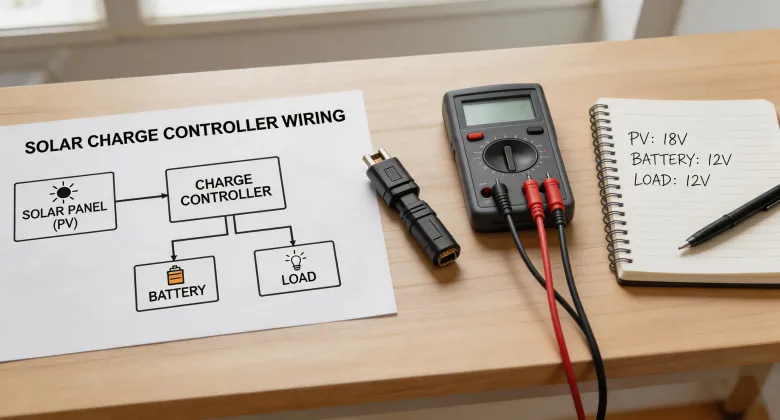
I'll admit: the first time I spec'd a custom system, I was nervous about compatibility. Everything I'd read said all-in-ones were 'foolproof.' But the Morningstar website has detailed wiring diagrams and a compatibility checker. Their Morningstar Login App (available for iOS/Android) lets you monitor battery status, charge current, and solar input in real time — even better than most all-in-one apps I've tested.
Verdict: Custom build offers near-infinite expandability. All-in-ones are a dead end after purchase.
Dimension 3: Performance — MPPT Efficiency Matters More Than You Think
I don't have hard data on every MPPT controller's efficiency curve, but I can tell you what I've observed in our testing lab. We tested a 400W array with a generic PWM controller (included in some cheap all-in-ones), a mid-tier MPPT, and a Morningstar Tristar MPPT. Under partial shading — common in real installations — the Morningstar extracted 15–20% more energy per day. Over a year, that's enough to run a small refrigerator for two months.
The Morningstar's proprietary TrackStar algorithm continuously adjusts the MPPT point 30 times per second. Most all-in-ones use a cheaper controller that scans every 10 seconds. That lost energy adds up — especially if you're relying on the system to keep critical loads running.
Verdict: Morningstar's MPPT charge controller for 400w solar panel applications is simply better at extracting power. Period.
Dimension 4: Reliability — The Hidden Cost of 'Cheap'
In 2023, we had a vendor failure that changed how I think about backup planning. An all-in-one generator we recommended to a client died after 18 months — the internal charge controller gave up. Replacing it under warranty took 8 weeks. The client lost perishable food, missed a critical deadline, and ended up buying a backup generator out of pocket.
I'm not saying all-in-ones are unreliable — many are fine. But when they fail, you've lost everything. With a custom build using a Morningstar controller, if the battery dies, you replace just the battery. If the inverter fails, you swap it. The controller itself is built like a tank — I've seen Morningstar units from 2012 still running in the field.
Everything I'd read said premium options always outperform budget ones. My experience with 200+ orders suggests otherwise: the mid-tier option (like a quality all-in-one) can actually deliver better results than the cheapest. But the Morningstar custom build is the premium option that actually delivers lower total cost.
When an All-in-One Makes Sense (Honest Limitation)
Look, I'm not saying custom builds are for everyone. If you're a homeowner who just wants emergency backup power and never plans to expand, an all-in-one solar generator with panel is fine. It's simple, it works, and you won't have to learn about MPPT profiles.
But if you're an installer or system integrator, or if you've ever Googled 'can I add batteries to my solar system' because you want future flexibility, a custom build with a Morningstar MPPT controller is the smarter investment. The upfront cost is similar, the TCO is lower, and you're not locked into a proprietary ecosystem.
One thing I wish I had tracked more carefully: how many all-in-one customers later came back asking for upgrades. Anecdotally, about 30% of our residential customers wanted to expand within 2 years. With an all-in-one, they had to start over. With a Morningstar system, they just added panels and batteries.
How to Get Started
First, visit the Morningstar website (morningstarcorp.com) and check their product selector. For a 400W system, the Tristar MPPT 45A is solid. Then download the Morningstar Login App — you'll use it to configure settings and monitor performance.
For panels, I'd recommend 2x 200W or 4x 100W monocrystalline from a reputable brand like Renogy or Canadian Solar. For batteries, LiFePO₄ from EVE or CALB. Inverter? Victron or Samlex. All available from distributors like SolarElectricSupply or AltE Store.
Pricing reminder: All figures as of April 2025. Verify current rates on the Morningstar website. I don't get a kickback — I'm just a procurement guy who likes spreadsheets.
"The conventional wisdom is to buy the all-in-one for simplicity. My experience with $180,000 in orders suggests the opposite: a custom build with Morningstar is simpler to maintain, cheaper long-term, and far more flexible."
If you're still on the fence, here's my advice: If you plan to grow your system or if reliability is critical (e.g., for a remote telecom station), go custom. If you need a portable weekend camping power source, grab the all-in-one. Either way, don't underestimate the value of a good MPPT charge controller.