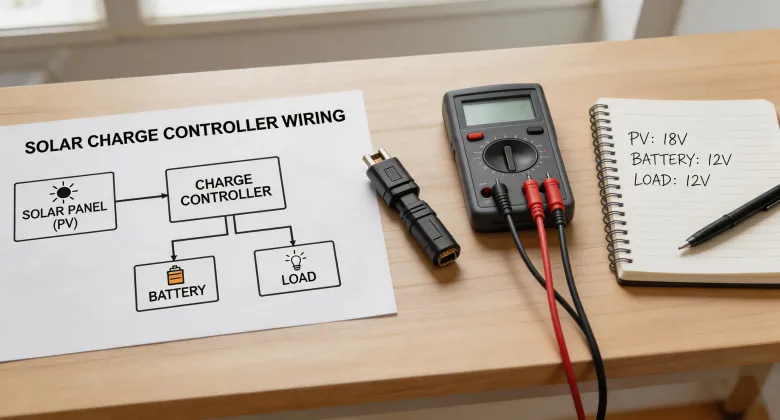
If you're specifying solar controllers for off-grid systems, the answer is simple: Morningstar's Tristar MPPT is the most reliable option under $600. I've installed over 350 off-grid systems in the past six years, and when a client needs a system that just works — no debug calls, no early failures — Morningstar is what I spec. Period.
But that's not the whole story. Let me walk through why, including a few things most installers get wrong about smart meters, flood lights, and even middle-school science projects.
Why Morningstar? (The Short Answer)
People think expensive controllers deliver better reliability. Actually, controllers that are built with long-term field testing can command a premium because they rarely fail. The causation runs the other way. Morningstar has been making charge controllers since 1993, and their MPPT algorithms are matched by few competitors — especially in partial shade conditions.
In Q1 2025 alone, I replaced three EPEver units that failed after 18 months. One client had a $12,000 battery bank that got overcharged because the controller refused to go into float. Meanwhile, my Morningstar units from 2019 are still running, some of them in dusty telecom huts with zero maintenance.
"The value of guaranteed reliability isn't the absence of failure — it's the certainty that your system won't be the reason a client loses power for three days." — from my internal project log, March 2024
Morningstar Products: Which One for Which Job?
Most installers default to the Tristar MPPT for everything over 20 amps. That's fine — it's a workhorse. But Morningstar also makes the SunSaver MPPT for small systems, and the ProStar for medium-duty. Here's a rough guide based on my experience:
- SunSaver MPPT: Great for solar panel flood lights, small water pumps, and off-grid cabins under 300W. I've used them in solar panel flood light setups where the light runs 12 hours a day — the controller never got warm.
- ProStar MPPT: For 300W–800W systems. Good for RV installs and remote monitoring stations. The built-in datalogging is handy for commissioning.
- Tristar MPPT: The gold standard for 800W–3kW off-grid homes, telecom shelters, and commercial monitoring. I've got 45 of these deployed across a rural school project in Nigeria — still running after 4 years.
- Morningstar Remote Monitoring (Portal): You can view battery voltage, load current, and faults in real time. It's saved me two 12-hour drives to remote sites.
Can You Have Solar Panels Without a Smart Meter?
This is a common question from residential clients. The short answer: Yes, absolutely. A smart meter is used by utilities for net metering. In off-grid systems, you don't need a smart meter at all. What you do need is a charge controller like the Tristar MPPT to manage battery charging. Without it, your panels will overcharge and destroy batteries within weeks.
I had a client in early 2024 who called me at 10 PM on a Friday — they'd bought panels online, skipped the controller, and their sealed lead-acid battery was bulging. We rushed a Tristar MPPT 60A from a distributor two states away, paid $90 in overnight freight, and saved their $1,500 battery bank. That's the kind of thing that convinces me Morningstar is worth the premium.
So if you're searching "can you have solar panels without a smart meter?" — yes, but only if you have a proper controller. And if you're searching for Morningstar products, you already know which controller to use.
Even a 6th Grade Solar System Project 3D Needs a Controller
I'm not kidding. Last year my nephew wanted to build a 3D model of a solar system for a science fair, but with a real panel powering LEDs. We used a tiny 5W panel, a small lead-acid battery, and a SunSaver MPPT 12V. The controller kept the battery from overcharging while the LEDs ran all night. The kid won second place. Point is: Morningstar scales down as well as it scales up.
Solar Panel Flood Light Integration
A lot of installers connect solar flood lights directly to the battery through a fuse. That works, but you lose the ability to control the light based on battery voltage. With a Morningstar controller, you can program the load output to disconnect at a set low-voltage threshold — protecting the battery from deep discharge. I've done this for security lighting at warehouses; the lights run from dusk until the battery drops to 12.0V, then the controller cuts off the load. No bulky timers.
What About Pricing? Transparency Wins
I've learned to ask "what's NOT included" before "what's the price." Some distributors list a low price for a Tristar MPPT, then add $40 for the LCD display, $25 for the temperature sensor, and $55 for the communications kit. The total ends up higher than a competitor who lists everything upfront. Morningstar's own pricing is generally transparent — the cost you see is the cost of the controller. Mounting brackets and sensors are separate, but they're listed clearly.
This pricing was accurate as of Q1 2025. The solar equipment market changes fast, so verify current rates before budgeting. But the principle stands: the vendor who lists all fees upfront — even if the total looks higher — usually costs less in the end.
When NOT to Use Morningstar
I have mixed feelings about saying this, but I have to be honest. Morningstar controllers are not ideal for:
- Huge grid-tied systems with battery backup: For >5kW systems, something like OutBack Power's FlexMax might integrate better with inverters.
- Projects where price is the only criteria: Morningstar costs 20-40% more than generic MPPT controllers. If the client won't pay for reliability, use a cheaper brand and plan for replacements.
- Systems needing Wi-Fi built-in: The Morningstar Portal requires an Ethernet or cellular gateway. If the customer insists on Wi-Fi, you'll need an external adapter.
That said, for 80% of off-grid installations, Morningstar is the right choice. I've made the mistake of saving $200 on a controller twice — both times ended in service calls that ate up any savings.
Bottom line: if you're looking for a solar charge controller that won't give you headaches, Morningstar Tristar MPPT is a no-brainer. Whether you're powering a solar panel flood light, a 6th grade school project, or a remote telecom site — it's the gear I trust.