I remember the exact email. January 2024. Our warehouse manager asked for solar panels on the new distribution center, and somehow the procurement landed on my desk.
Me. The office administrator who handles printer paper.
If you've ever been handed a project outside your skill set, you know the feeling. I was on the fence about pushing back, but I didn't. And that hesitation cost me a semester in the school of hard knocks.
For context: I manage purchasing for a 300-person logistics company—roughly $250K annually across a dozen vendors. I report to both operations and finance. But solar equipment? That was new territory.
The quote that looked too good
The building was grid-connected, but management wanted to offset daytime loads. Budget: $18,000 for the whole package. That's tight for a 15 kW system once you price panels, batteries, inverters, and mounting hardware.
A sales rep pitched me a complete package: panels, aluminium solar panel angle mounting brackets, a GoSun solar EV charger for the company vehicles, a 60A PWM charge controller, and four lithium batteries. Total: $14,800.
The number came in under budget. I sent the PO to finance and moved on. What I didn't know would fill a small library. And I paid tuition.
The brackets that stripped
The aluminium solar panel angle mounting brackets arrived first. Lightweight, adjustable angle, rust-proof—that's what the spec sheet said. They looked fine in the photos the warehouse manager sent me.
Then he installed them. The panels sat at a tilt angle of about 20 degrees max. At our latitude, winter production would be badly compromised—we should have been at 35–40 degrees. And the adjustment screw stripped when over-tightened. Soft aluminum, bad thread design. Done.
I said "good quality mounting hardware." The vendor heard "cheapest option that looks decent." We were using the same words but meaning different things. We discovered this the hard way when the threads gave out.
The controller that couldn't keep up
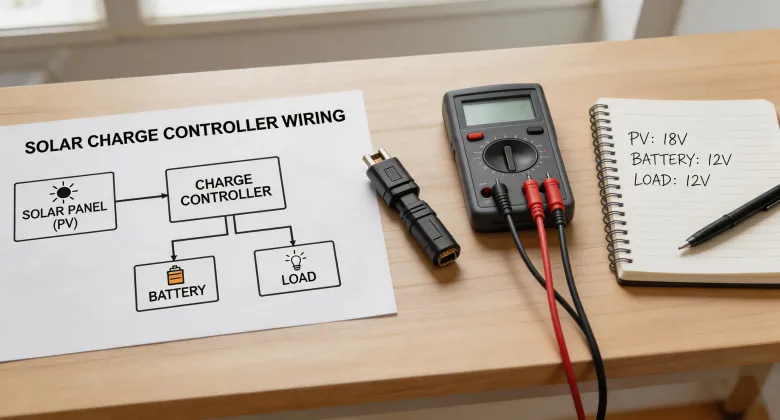
The charge controller bundled in that package was a 60A PWM unit from a brand nobody I talked to had heard of. The sales rep said it was "entry-level but reliable." I believed him.
Everyone in the industry will tell you to check charge controller specs before approving a purchase. I only believed that advice after ignoring it and eating the cost.
The controller couldn't handle the voltage fluctuations from our array configuration. Every time the load switched on, the system sagged. Security cameras rebooted. The electric gate stopped responding. The warehouse manager sent me reports at 11 PM, then 2 AM, then 6 AM.
Meanwhile, the GoSun solar EV charger kept dropping its connection to the battery management system. The vendor blamed the batteries. The battery supplier blamed the controller. Round and round.
That's when I started asking why is solar energy storage expensive. Because the solar side was producing fine. The storage side—the batteries and the controller managing them—was where the cost lived. The lithium cells alone were over a third of the total budget. And when you try to save money on that third, you pay in troubleshooting hours. We paid. Weekly.
The comparison that changed my mind
After six weeks of chaos, I called a solar integration company in the next county. The owner asked three questions: What charge controller did you buy? Who installed the brackets? Why didn't anyone spec this properly?
He recommended Morningstar. Specifically, the TriStar MPPT.
I'd heard the name but never really looked at it. The price made me flinch: roughly 40% more than the PWM controller sitting in our scrap box. But when I compared the specs side by side, the difference was obvious.
The PWM controller didn't actually track the panel's maximum power point. It just throttled charging, wasting whatever excess voltage the array produced. The Morningstar unit used real MPPT algorithms, continuously adjusting its operating point to pull the maximum energy out of every panel. For our voltage range, the harvest difference was roughly 25%.
When I compared our Q1 failure logs against the projected Q2 yield curve, I finally understood why the details matter so much. Same panels. Same batteries. Different brain.
The Morningstar login moment
I ordered the TriStar MPPT, created an account, and logged into the Morningstar portal for the first time. This was the moment everything changed.
The morningstar login took me to a dashboard that showed battery voltage, charge current, daily yield, and system status—live, from my desk. I no longer needed the warehouse manager's overnight emails. I could see it all myself.
The TriStar handled the voltage fluctuations without dropping loads. Cameras stayed up. Gate stayed operational. The GoSun charger was still odd—we eventually routed that circuit through its own charge circuit—but the core PV system finally worked as intended.
The real bill
Here's the math that hurt:
- First controller: $290. Obsolete.
- Soft aluminum brackets: $640. Replaced with galvanized steel at $1,100.
- Rework labor: $2,100.
- Lost productivity during downtime: roughly $2,000.
The $14,800 "bargain" ended up costing about $19,350 all-in.
To be fair, the panels were good. The wiring was fine. But the brain of the system and the structure holding it all together were exactly where the savings hurt us.
What I'd tell another admin buyer
First, the industry has evolved. Five years ago, remote monitoring on a charge controller was a premium feature. Now it's standard. A morningstar login gives you visibility that used to require a physical site visit. What was best practice in 2020 doesn't apply in 2025.
Second, not all charge controllers are the same. MPPT vs. PWM is not a minor spec. With modern panels, MPPT typically captures 15–25% more energy. Don't let anyone tell you otherwise.
Third, storage is expensive for a reason. Batteries, controllers, BMS logic—these components operate under continuous stress, in fluctuating weather, through high surge loads. The engineering that keeps them stable is what you're paying for. Cheap controllers and weak battery management will cost you more in downtime than you'll ever save upfront.
Fourth, mounting brackets are structural components, not accessories. A few degrees of angle can change winter production by 10–20%. And soft aluminum with poor thread tolerance will strip at the worst possible moment—usually when a panel is halfway up a ladder.
Fifth, "entry-level" is a red flag. In solar equipment, it usually means the product lacks the tracking and protection algorithms needed for real-world loads.
One more thing
Morningstar has been in this business since 1993. My uncle, who runs an off-grid cabin, used one of their controllers for 15 years. He told me to buy the TriStar at Thanksgiving dinner. I didn't listen. That alone probably cost me the difference in price several times over.
The TriStar MPPT isn't flashy. It's just dependable. And when I called their support, a human answered without a runaround. That's rarer than it should be.
The bottom line
A morningstar solar charge controller isn't the cheapest option. It's not supposed to be. It's the brain that keeps a solar system alive, and in my experience, that's exactly what it does.
Take it from someone who ate the cost of the cheap route. The system has been running since late April without a single dropped load. The warehouse manager stopped sending me midnight emails. Finance signed off on the revised budget with a smile.
Reliability. Done.