-
My original mistake about charge controllers
-
Why Morningstar made it into my purchasing rotation
-
What about a solar charger with inverter?
-
The other Morningstar: why this is not a solar system astronomy post
-
What to look for in a solar generator: my procurement checklist
-
What about the people who say just buy a cheaper one?
-
Bottom line
If you are asking what to look for in a solar generator, start with the part that most product pages hide: the charge controller. I started managing off-grid solar procurement six years ago, and I have tracked about $180,000 in related spending since then. The most preventable budget overruns did not come from panels, batteries, or inverters. They came from controllers that failed under real-world heat and dirty power. The cheapest box between the modules and the battery is usually the most expensive thing in the system.
My original mistake about charge controllers
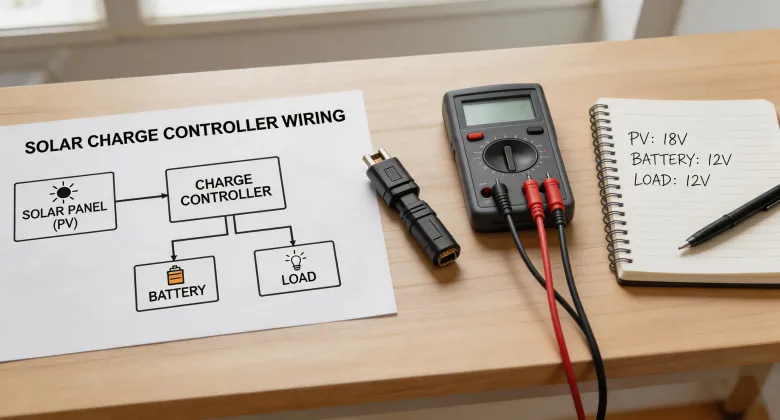
When I first bought solar equipment, I assumed a charge controller was basically a voltage gate. I spent hours comparing battery capacity and inverter surge watts, and almost no time on the little box with the terminal lugs. That was wrong. A charge controller decides how much current goes into the battery, when to stop, and how to handle a cloudy day that suddenly turns bright. A bad one can ruin a $3,000 battery bank in one season.
The hard part is you cannot see this on a spec sheet. You can see efficiency, voltage limits, and temperature ratings. What you cannot see is how the controller behaves when a panel is partially shaded, a lithium battery trips its internal disconnect, or the ambient temperature hits 110°F. That is where the real money lives.
Why Morningstar made it into my purchasing rotation
I am not a brand ambassador. I keep a spreadsheet that compares total cost of ownership, not initial invoice. Morningstar products did not win every line item. But they win the final number because they fail less and behave predictably. According to the Morningstar website, the TriStar MPPT family reports peak efficiency above 98%, and the company publishes derating curves instead of hiding them. That transparency saves me hours of engineering time.
It took me three years and about forty system orders to realize that reliability matters more than a half-point of efficiency. A controller that loses 2% efficiency but runs for 15 years with no field failures will beat a controller that claims 99% efficiency and dies at 14 months. I learned this after a cheaper controller killed a battery bank. The saving on that first purchase was maybe $400. The replacement battery, labor, and downtime came to $7,300. That is not a rounded-up number; that is from my cost tracking system.
Morningstar products are not flashy. They are mostly black boxes with small displays and no unnecessary Wi-Fi marketing fluff. But they are predictable, and predictability is a procurement metric. If I send a technician to a remote site, I want a controller that has been through the same conditions before and has documentation for it.
One example from my records: in 2023, I compared two quotes for a 24-volt off-grid monitoring station. The cheaper quote used an MPPT controller with no remote monitoring. The Morningstar quote cost 34% more upfront. But when I added the cost of a site visit to pull data, $350 per trip, the Morningstar option paid for itself in the first three months. We could see the state of charge from the office and schedule maintenance before the batteries sat at low voltage for a week.
What about a solar charger with inverter?
One search phrase that comes up often is solar charger with inverter. I get the appeal. A combined unit saves mounting space and reduces wiring. But from a total cost view, separate units often win. The charge controller and inverter both generate heat. When you pack them into one enclosure, the operating temperature rises, and the components derate sooner. On a small system that might be fine. On a 5 kW off-grid installation with the controller and inverter in a metal box in the Arizona sun, I would rather split them.
Another reason to separate them is troubleshooting. If one box does everything, you cannot tell if the converter side or the charging side caused the fault. With Morningstar, I can pull a history from the controller and see exactly what the input voltage did before the fault. That is prevention over cure: five minutes of diagnostics beats five days of guesswork.
There is also a single point of failure problem. If the charging side dies in a combined unit, the inverter side usually stops working too. With separate units, you can keep the inverter running on a generator while you replace the controller. That flexibility matters when uptime is part of your customer contract.
The other Morningstar: why this is not a solar system astronomy post
Before the checklist, one clarification. If you searched for solar system astronomy and landed here, you were probably looking for the morning star, Venus, not the solar equipment company. This article is about Morningstar, the charge controller manufacturer. But the connection is not as odd as it looks: both are about observing things before you commit. Astronomers call it prediction. Procurement calls it prevention.
What to look for in a solar generator: my procurement checklist
Here is the checklist I now use whenever a sales rep sends a quote for a solar generator or an off-grid kit. I built it after a $1,200 mistake, and it has saved us an estimated $8,000 in potential rework.
- Charge controller brand and type. If it does not say MPPT, treat it as a red flag. PWM controllers have their place, but in a generator package, you want MPPT for the efficiency and the ability to handle varying input voltage.
- Published derating data. Can you find the controller's operating temperature curve? If the manufacturer does not publish it, assume the worst.
- Inverter quality. Pure sine wave is a no-brainer for sensitive loads. If the quote says modified sine somewhere, keep looking.
- Monitoring. A controller with data logging is worth the extra cost. Remote monitoring, like Morningstar Portal, turns a blind spot into a maintenance schedule.
- Spare part lead time. Ask the vendor: if this controller fails in 18 months, where is the replacement? The answer will tell you more than any brochure.
What about the people who say just buy a cheaper one?
You can absolutely buy three generic controllers for the price of one Morningstar. I have made that argument myself, and it lost. On paper, the generic option looks fine. In practice, the cost of a field failure includes the replacement unit, shipping, a truck roll, the time you did not generate power, and the load that did not run. One failed controller cost a customer about $11,000 in lost throughput before we swapped it. The controller itself was $180. That is not an argument against competition. It is an argument against buying a solar generator based on the front panel instead of the controller behind it.
To be fair, generic controllers are not all bad. I still use them in very simple, low-risk solar kits where the load is a few LED lights. But if the load is a telecom repeater or a refrigeration unit, the controller is not an accessory. It is the insurance policy.
Bottom line
What to look for in a solar generator? Honestly, start with the charge controller. Then look at temperature ratings, monitoring, and total cost of ownership. If that points you toward a Morningstar product and a separate solar charger with inverter, so be it. If it points you elsewhere, at least you checked.
I still keep a column in my spreadsheet for reliability, after the fact. It is the only column that matters. Prevention over cure is not a slogan; it is the line item that keeps your site online and your budget predictable. Trust me on this one.