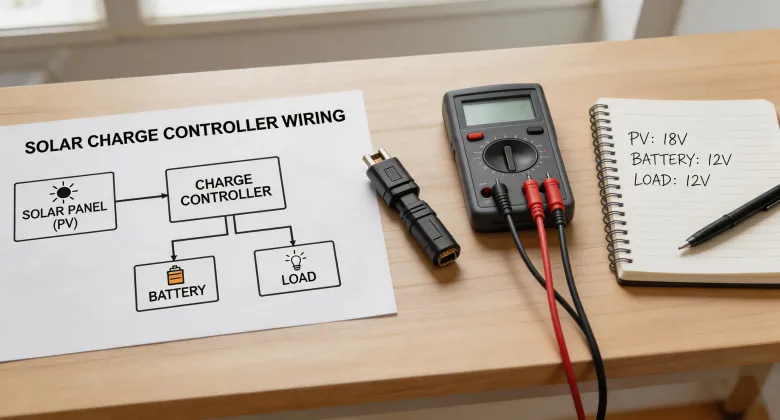
Here's an unpopular opinion: if you're an off-grid installer who politely dismisses “small” projects — the home with a battery but no solar panels, the 50W trickle-charge question, the single-controller order — you're not saving time. You're losing your next big account on purpose.
I say this as someone who's made that exact mistake, repeatedly. I'm an installation manager handling replacement and custom off-grid orders for eight years. I've personally made, and documented, six significant mistakes worth roughly $12,000 in wasted budget. Now I maintain our team's pre-install checklist, mostly to keep myself from repeating my own dumbest moves. This is one of the dumber ones.
The $70 Question I Almost Ignored
In early 2017, a homeowner emailed us about a NOCO solar battery charger. She had a 20W panel and a 12V AGM battery in her garage — no roof panels, no inverter, no transfer switch. Just a battery box, a small panel, and a question about whether a NOCO charger would work as a solar regulator.
My first thought: “That's a $70 product question. We sell $2,000 controllers. Pass.”
I responded. The response was technically correct, professionally written, and dead. No phone call. No “tell me more about the setup.” No follow-up. I logged it as a service-stage lead and moved on.
Four years later, we bid a 4kW off-grid community center project. The architect sent back questions comparing our quote with a firm 30 kilometers away. I recognized her name. Same homeowner. She'd bought the NOCO charger, it wasn't right for what she actually needed, and the other firm had answered her follow-ups for a year. “They took my tiny battery problem seriously,” she said. That phrase hurt. I have the same skill set. I just chose not to use it.
The bid went to them, by the way. $19,000. Over a $70 product question.
Battery-Only Homes Are Not Dead Ends
Here's what I've learned since: home battery no solar panels is not a failed project. It's a staging decision. A surprising number of households buy the battery first and the panels a season later — for financing reasons, permit timing, or simply because they want the storage infrastructure in place before the rooftop work starts.
The surprise wasn't that these customers exist. It's how many of them are staging a bigger plan. In the past 18 months, we've quoted twelve battery-only homes. Six came back for a solar array within a year. Two came back for a second battery. One became the community center project. None of the initial orders were large. All of them were cheap to serve — once we built the systems.
Now, every battery-only proposal includes a small charge controller as a maintenance charger, connected to our monitoring before we leave the site. The customer gets a monthly “your battery is healthy” notification. We get a low-effort touchpoint that costs one hour and opens a relationship.
MPPT vs PWM Charge Controllers: The Difference, and Where I Got It Wrong
Here's the thing: I've made the MPPT vs PWM charge controller decision wrongly in both directions, and both times it was on a small order.
First mistake: a 50W panel charging a 12V gate battery. I quoted an MPPT controller because “MPPT is the premium option.” Short wire run, mild climate, plenty of sun. A PWM unit would have delivered the same result for half the price. The customer paid for capability they never used — and installers like me wonder why buyers lose trust in recommendations.
Second mistake: a cabin with two 300W panels and a 25-meter cable run, powering a small fridge. I used a PWM controller because one was in stock. The voltage drop meant that battery spent winter around 75% state of charge. When I finally swapped in an MPPT unit, charge current improved by roughly 20-25% on the same panels. That cost us a $2,100 controller swap plus the embarrassment of explaining it.
What I mean is: the difference between MPPT and PWM isn't “premium vs budget.” It's engineering fit. Let me restate that, because I've watched busy installers make this exact mistake on small orders.
PWM (pulse width modulation) toggles the panel's connection to the battery. The battery voltage effectively pulls the panel down, so panel voltage above the battery's charging voltage is wasted. It's simple, robust, and fine when a modest panel sits close to a 12V battery.
MPPT (maximum power point tracking) runs the panel at its optimum power voltage, then converts that higher-voltage DC down to the battery's charging voltage. The real gains show up when:
- Panel voltage is significantly higher than battery voltage (a 36V panel on a 12V bank)
- Temperatures are cold, which raises panel voltage
- Wire runs are long, because you can push higher voltage to the controller and convert it down near the battery
- You're charging 24V or 48V banks
My general rule: for 50-100W panels close to a 12V battery, PWM is the honest recommendation. For anything larger, colder, farther, or higher-voltage, MPPT earns its premium. That phrasing is now item 4 on our team's checklist. Costs me nothing. Saves customers hundreds.
And since the FTC's advertising rules (ftc.gov) require performance claims to be substantiated, let me be precise: that 20-25% cabin improvement was site-specific, not a universal product promise. Your results will differ. That's the point. Engineering fit beats a marketing template.
The Morningstar App and Store Changed Our Small-Job Economics
I resisted the idea of monitoring small jobs. “I don't need an app, I need a technician with a multimeter,” I said. That was stupidity disguised as toughness. A $400 job with one site visit plus ten minutes in the Morningstar app is more profitable per hour than a $20,000 job that eats three weeks of travel and five rework visits.
We now connect every controller to the app before we finish the install. For battery-only homes, that means a notification if state of charge drifts below threshold. During a recent winter outage, one customer's battery floated for months on a small maintenance controller, and we watched the voltage graph from the office. No truck roll. No “is it okay?” calls. The app handled it.
On the purchasing side, the Morningstar store organizes things by product family rather than by application, which took me a while to get used to. I'm still not sure why — my best guess is it's cleaner for distributors. But the documentation is thorough enough that our warehouse staff can stage a correct kit from a part number without guessing. That's worth more to us than a prettier catalog.
Part of me wants to consolidate to one controller model for simplicity. Another part knows that keeping a PWM and MPPT tier keeps our proposals honest. I compromise with a two-tier system: a SunSaver-class PWM for maintenance loads, a TriStar MPPT for anything with real array voltage.
The Pushback I Get (and Why It Doesn't Change My Mind)
“Small jobs have the same paperwork as large ones,” installers tell me. “Nobody makes money on a $200 order.” I used to say that too. It's wrong — not because small orders are profitable in themselves, but because they're the cheapest customer acquisition channel most of us ignore.
The fix isn't to charge small customers more or to send them away. It's to build systems that make small jobs cheap: a battery-only proposal template, a predefined 50W maintenance kit, remote monitoring instead of repeat truck rolls, and a fast, polite “no” when a job genuinely doesn't fit. A checklist, essentially.
So yes, the upside is a future customer base. The risk — and I calculated this at the time — was spending a technician's day on a job that paid almost nothing. I kept asking myself: is goodwill worth burning a billable day? I've now seen the answer from both sides of the spreadsheet. The goodwill paid for itself within one referral.
To be fair, most small customers won't call you again. At least, that's been my experience. Maybe two in ten come back. But that twenty percent pays for the other eighty by a wide margin, and the referrals compound.
The Checklist Version
Look, I know a $200 order doesn't feel like strategy. It didn't to me either. But every small customer is a future decision-maker, and their question — “What's the right charge controller for my small battery?” — deserves the same diligence as a 100kW commercial spec.
Give it the same engineering answer, the same documentation, the same follow-up you'd give a large system. The homeowner asking about a $70 NOCO charger today is the architect signing a $19,000 bid tomorrow. Or the competitor's. Your call.
Small doesn't mean unimportant. Small means potential. That lesson cost me about $12,000, and I'd rather you learn it for free.