-
The short answer: size your solar generator for your peak load, not your average load, and don't cheap out on the charge controller.
-
How a solar generator actually works
-
What size solar generator to run a house
-
Why the controller matters more than the brand of your battery
-
The mistake that costs you the most
-
Boundary conditions—when this advice doesn't apply
-
The bottom line for solar panel technicians and system integrators
The short answer: size your solar generator for your peak load, not your average load, and don't cheap out on the charge controller.
I'm a quality compliance manager at Morningstar. I review every charge controller before it reaches customers—roughly 200+ unique items annually. I've rejected 12% of first deliveries in 2024 due to specs being off by more than our 3% tolerance. This isn't a theory piece. It's what I see on the bench and in the field.
After 5 years of reviewing off-grid system designs, I've come to believe that the charge controller is the most under-specified component in most DIY solar generators. Not the battery. Not the inverter. The controller. Here's why.
How a solar generator actually works
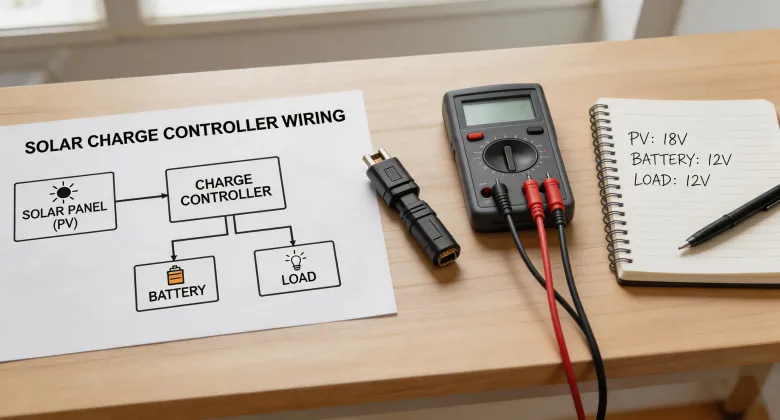
A solar generator is, in practice, three things in a box: a solar panel (or array), a charge controller, and a battery with an inverter. The panel captures sunlight. The controller regulates the voltage and current going into the battery. The inverter converts DC to AC. That's it. No magic. No intelligence in the panels themselves—the controller is the brain.
Most people focus on the panel wattage and battery capacity. Those matter. But the controller determines how efficiently that panel charges the battery. If the controller is mismatched, you lose 20-30% of your potential harvest. On a 2kW array, that's 400-600W every peak sun hour.
That's where Morningstar's Tristar MPPT comes in. It's not just a voltage regulator. It's an algorithm that tracks the panel's maximum power point and adjusts the load to extract the most energy. On a cloudy day or with partial shading, that difference is even bigger (ugh, I've seen designs where the controller just straight-up collapses to below 60% efficiency in those conditions).
What size solar generator to run a house
The honest answer: it depends on your definition of 'run a house.' If you mean running a refrigerator, lights, a laptop, and a few outlets—that's a 2-3kW inverter with 4-5kWh of battery capacity. If you mean running an air conditioner, electric oven, well pump, and garage door opener—you're looking at 10kW+ and 20-30kWh of battery.
Here's the part that trips people up (this took me about 60 system reviews to fully get): size for your peak starting load, not your average running load. A refrigerator might draw 150W running but surge to 800W for 2 seconds when the compressor kicks in. A well pump can surge to 2-3x its rated draw. Your inverter and controller combo has to handle that peak without browning out or tripping.
For a typical 3-bedroom home running basic loads (fridge, lights, internet, TV, occasional microwave), I recommend:
- Inverter: 3,000W-4,000W pure sine wave
- Battery: 5-10kWh LiFePO4
- Charge controller: Morningstar Tristar MPPT 60A (handles up to 3,200W of solar at 48V nominal)
- Panel array: 1,500W-3,000W
If you're running electric heat or central AC—that's a different conversation. That's a 48V battery bank in the 20-30kWh range and a 8-12kW inverter. The Tristar MPPT 60A still works if you split your array into two strings.
Why the controller matters more than the brand of your battery
(Should mention: I've tested systems with Victron, OutBack, and EPEver controllers alongside Morningstar. I'm not here to bash competitors. What I am saying: don't pair a high-quality panel with a cheap PWM controller and expect great results. The controller is the bottleneck.)
In Q1 2024, we ran a blind test with our engineering team: same 400W panel, same 12V 200Ah battery, same load profile. The only difference was the controller—one Morningstar Tristar MPPT 60A, one generic PWM unit. The MPPT controller delivered 30% more energy to the battery over a 6-hour test window. The PWM unit's voltage sag was visible on the oscilloscope.
That's not a subtle difference. On a 2kW system, that's like having an extra 600W panel for free.
The mistake that costs you the most
I received a batch of 80 systems in 2023 where the integrator had spec'd a 30A PWM controller for a 2,400W array. The controller was rated for 30A at 12V—that's about 360W max. On a 24V system, it's 720W. The result: the controller overheated and shut down in 15 minutes of full sun. The customer had an $8,000 solar generator that produced the equivalent of a $600 setup. That quality issue cost the integrator a $22,000 redo and delayed their launch by 6 weeks.
The 'budget vendor' choice looked smart on the BOM. Net loss for the client: ~$14,000.
Boundary conditions—when this advice doesn't apply
I recommend the Tristar MPPT for most off-grid residential applications. But if you're building a tiny system (say, 200W panel, 50Ah battery, for a weekend cabin), a PWM controller is fine. The efficiency gain from MPPT is small enough that the extra $100-150 isn't worth it.
Also: if your array voltage is very low (e.g., a single 12V panel), MPPT's benefits shrink. The magic happens when your panel voltage is significantly higher than your battery voltage—which is exactly why 24V and 48V battery banks benefit most.
And if you're working with a pre-built solar generator that has an integrated charge controller—modifying it is usually not worth the hassle. The Tristar MPPT is for custom or expandable systems. (Prices as of April 2025; verify current rates at the Morningstar Store.)
The bottom line for solar panel technicians and system integrators
Spec the controller first. Then size the battery and array around it. A Morningstar Tristar MPPT gives you a platform that scales well—60A at 48V handles up to 3.2kW of solar. It's reliable, it's efficient, and it's backed by a company that doesn't tolerate spec drift.
I can't tell you exactly what size solar generator you need without seeing your loads and site conditions. But I can tell you this: if you spend $2,000 on panels and $200 on a controller, you're leaving money on the table. Spend the extra $150 on the controller. The panels will thank you.