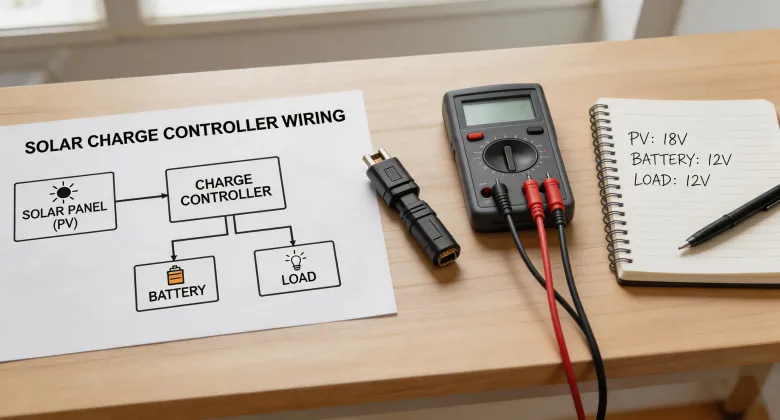
There's no one-size-fits-all answer when picking a solar charge controller—especially for off-grid systems. What works for a remote telecom tower in Arizona won't work for a livestock water pump in Montana or a cabin in the Adirondacks. The right choice depends on your load profile, panel configuration, and how much risk you can tolerate.
Here's the thing: most buyers pick a controller based on price or brand familiarity. That's how you end up with a system that works but underperforms—or worse, one that fails mid-winter when you need it most. I've been managing commercial off-grid purchases for years, and I've learned that the cheapest option upfront is rarely the cheapest overall.
Three Scenarios, Three Answers
Before diving into models, let's figure out which camp you're in. These are the most common setups I see in commercial off-grid:
- Scenario A: Small-to-medium off-grid system, 12V or 24V battery bank, 400W–2kW of solar, occasional loads (lights, pumps, small appliances).
- Scenario B: Large off-grid system, 24V or 48V battery bank, 2kW–10kW of solar, critical loads (base stations, remote monitoring, essential infrastructure).
- Scenario C: Hybrid scenario—you're upgrading an existing system or mixing panels with different specs.
Your scenario determines whether MPPT is worth the premium, or if a well-designed PWM system makes more sense. Let's walk through each.
Scenario A: Small to Medium Off-Grid Systems (12V / 24V, Under 2kW Solar)
If you're powering a remote gate opener, a few security cameras, or a small pump station, a Morningstar MPPT controller is often overkill—and not in a good way. The extra cost and complexity don't always pay back on small systems, especially if your load is predictable and your panels are matched to your battery voltage.
Looking back, I should have gone with a Morningstar ProStar MPPT or even the SunSaver MPPT for my first small install. At the time, I thought the bigger TriStar MPPT was 'future-proofing.' It wasn't. I paid extra for capacity I never used, and the installation was more complex than needed.
My recommendation:
- ProStar MPPT (15A–45A): Ideal for 12V/24V systems up to about 800W solar. It's a workhorse—reliable, programmable, and the remote monitoring option (via Morningstar Portal) is a nice touch for checking status without driving out to the site.
- SunSaver MPPT (10A–20A): For very small systems (under 400W). Simple, potted electronics for harsh environments, and it's surprisingly efficient for a compact unit. But no digital display—you'll need the handheld meter for diagnostics.
The counterintuitive take: A 50 amp solar controller (like the TriStar MPPT 45A or 60A) is too much for small systems. You're paying for capacity you won't use, and the larger unit may have higher standby losses that eat into your tiny energy budget. Don't 'upsize for safety' on a small install.
Scenario B: Large Off-Grid Systems (24V / 48V, 2kW–10kW+ Solar)
This is where Morningstar's MPPT technology really earns its keep. If you're running critical loads—like a telecom tower, remote weather station, or essential water pumping—a few percent more efficiency translates to real savings over the system's lifetime.
I once spec'd a Tristar MPPT 60A for a 4.8kW solar array powering a remote base station. The alternative was a cheaper PWM unit from another brand. The upfront difference was about $400. But after factoring in the higher kWh harvest from MPPT (especially during winter months when panels are cold and voltage is higher), the payback period was under 18 months.
My recommendation:
- Tristar MPPT 45A or 60A: The gold standard for mid-to-large off-grid. Supports up to 150V or 600V PV input (depending on model), which means you can use higher-voltage panels and thinner wire—saving on copper costs for long runs.
- Tristar MPPT 600V: If you're dealing with very long wire runs (over 200 feet) or a high-voltage array, the 600V model eliminates the need for a combiner box and reduces wiring losses significantly.
Risk weighing: The upside of going MPPT is 15–30% more energy harvest (per Morningstar's specs and industry data). The risk is the upfront cost. I kept asking myself: is $400–800 extra worth getting 20% more power in winter? For critical loads, yes. For seasonal loads (like a summer-only pump), maybe not.
Scenario C: Mixed Panels or System Upgrades
This is where things get tricky. Maybe you're inheriting an existing system with mismatched panels, or you're expanding an older setup. MPPT vs PWM solar charge controller becomes a critical decision here.
I still kick myself for not checking the panel specs before upgrading a client's system. They had 60-cell panels (typically ~30–40Vmp) on a 24V battery bank, and the existing PWM controller was wasting about 30% of the panel's potential (since PWM can only use the panel's current, not its voltage). We upgraded to a TriStar MPPT and instantly saw a 25% increase in daily amp-hours—with the same panels.
Here's the rule of thumb: If your panel's Vmp (maximum power voltage) is more than about 1.3–1.5x your battery voltage, MPPT will pay off. If they're closely matched (e.g., 12V panel on a 12V battery), PWM is perfectly fine and cheaper.
If you're mixing panels with different specs: Morningstar's MPPT controllers handle partial shading and mismatched panels better than PWM, thanks to their advanced algorithm. But they still work best when panels are well-matched. Don't expect magic from mixing 60-cell and 72-cell panels on the same controller—you'll lose efficiency.
How to Know Which Scenario You're In
Still unsure? Run through this quick checklist:
- Battery voltage and system size: 12V system under 1kW? You're probably Scenario A. 24V or 48V with over 2kW? Scenario B.
- Panel specs: Grab the Vmp and Voc from the panel datasheet. If Vmp is over 18V for a 12V system (or 36V for a 24V system), MPPT is likely worth it.
- Criticality of loads: If a failure means losing revenue or causing safety issues (like lights on a remote runway), invest in MPPT and monitoring. If it's a backup pump that runs once a month, PWM may suffice.
- Wire runs: Long distances from panels to controller? Higher voltage (via MPPT) means smaller wire gauge and lower cost.
Which Morningstar product fits your setup? Here's a quick cheat sheet:
- SunSaver MPPT: Tiny systems, harsh environments, simple loads.
- ProStar MPPT: Mid-sized systems, needs remote monitoring, reliable all-rounder.
- Tristar MPPT 45A–60A: Large systems, critical loads, maximum efficiency.
- Tristar MPPT 600V: High-voltage arrays, long wire runs, maximum flexibility.
For reference, Morningstar's documentation (available on the official website) provides detailed sizing guidelines per model, including PV input voltage ranges and recommended battery configurations. Per industry standards, MPPT efficiency for Morningstar controllers is typically quoted at over 99% peak, which translates to significant real-world gains in colder climates.
At the end of the day, the right controller is the one that matches your specific site conditions and budget. Don't let a salesman upsize you into a controller you don't need—and don't under-size for a critical load to save $200. The middle path, as usual, is knowing the specifics of your site and doing the math.