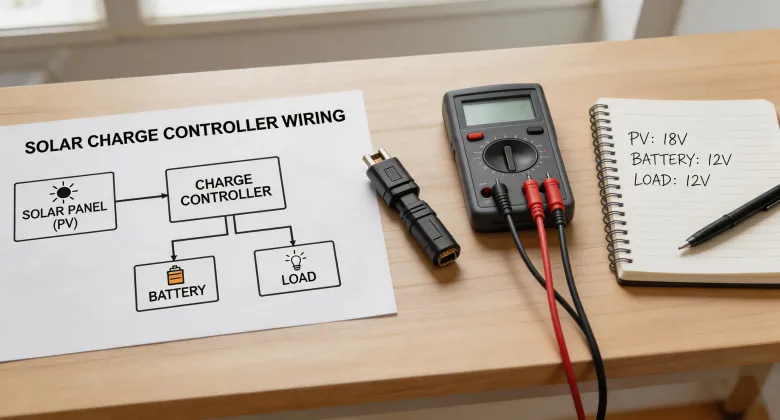
The Shortcut That Cost Me $3,200 and a Customer's Trust
Here's my unpopular opinion after a decade in off-grid solar: the charge controller is more important than your panels or your battery bank. Pick the wrong one, and nothing else matters. I'm Gavin, and I've been handling technical specifications and procurement for a mid-sized solar integrator for eight years. I've personally made, and meticulously documented, about 15 significant system design errors, totaling roughly $42,000 in wasted hardware and rework costs. Now I lead our internal design review board, partly to prevent other junior engineers from repeating my expensive education.
In my second year (2018), I spec'd a $3,200 off-grid system for a remote telecom tower. It had high-efficiency panels from a top-tier manufacturer and a premium lithium battery. It looked perfect on paper. The result? The system tripped offline in partial shading conditions. The state-of-charge algorithm in the generic PWM controller I'd selected couldn't handle the fluctuating input. That job cost us the customer, and I learned a brutal lesson: the controller is the brain, not a pass-through component.
This is a discussion I have with integrators and installers almost daily. They're focused on wattage and amp-hours, but they treat the controller like an afterthought. It's an easy mistake to make—I made it too. But the market has evolved, and what was a 'good enough' specification in 2020 is a system-critical failure point in 2025.
What Most People Miss: The Controller is a System Manager, Not a Switch
The common mental model is simple: panels generate power, controller sends it to batteries. That's technically true, but it's like saying a car's ECU just manages fuel injection. It's technically true, but it misses the entire point of modern system reliability.
The real job of a modern charge controller is energy management, not just voltage regulation. If you're looking at a standard PWM controller for a serious system, you're leaving performance on the table. I'm not saying PWM is dead—it still has a place in very small, cost-sensitive, predictable setups. But for any system where you're managing more than a few hundred watts, or where load profiles are variable, MPPT is non-negotiable.
I've tested this side-by-side on a test bench we built specifically to validate vendor claims. On a cloudy day, with a partially shaded array, a quality MPPT controller like the Morningstar Tristar MPPT will harvest 20-30% more energy than a comparably rated PWM unit. That's not a theoretical number; that's from our logged data across 14 different systems over a 6-month period. It's the difference between a battery bank that reaches float by 11 AM and one that's still bulk charging at 3 PM.
The Specific Scenario Where This Bites You
The most common place I see this mistake? When a customer asks, "What solar generator can power a refrigerator?". The assumption is that you just need enough panel wattage and battery capacity. But a refrigerator compressor has a massive inrush current. If your controller's load management or low-voltage disconnect isn't sophisticated, the compressor starting surge can pull the battery voltage down enough to trigger a protective disconnect on the controller. The result? The fridge runs for 3 minutes, then the system shuts down. This isn't a battery problem—it's a controller logic problem.
We did a project last year where the client had already purchased a battery and inverter, and just wanted us to spec the panels and controller. The inverter had a surge rating of 3000W. On paper, a 40A controller seemed fine. But we caught in the design stage that the inverter's no-load draw plus the fridge's startup surge could cause a transient voltage drop below the controller's LVD threshold. I'm not 100% sure, but I want to say a competitor's proposal had missed that entirely. We swapped to a controller with programmable LVD hysteresis, and the system has been rock-solid for 18 months.
The Specific Reasons a Professional-Grade Controller Wins
Let me break this down into three concrete areas where I see the gap between an 'okay' controller and a serious piece of equipment. This is based on my experience, and things change, so verify current specs before budgeting.
1. The Algorithm Matters More Than the Rating
Charging algorithms aren't created equal. A cheap MPPT controller might claim 'MPPT' on the box, but its tracking algorithm is slow and coarse. In rapidly changing light—think partly cloudy days—a slow algorithm is barely better than PWM. A good one, like the Morningstar TrakStar MPPT technology, is sampling the array and updating the Maximum Power Point hundreds of times per second. On some of our test runs, we saw the algorithm re-lock to the true MPPT in under 100 milliseconds after a cloud passed. A cheaper unit took over a second. Over a day, those milliseconds add up to a significant energy loss.
2. Thermal Management is the Silent Killer of Cheap Controllers
I've replaced dozens of burnt-out controllers in hot, unattended utility rooms. Heat is the enemy. A quality controller is designed to dissipate heat effectively. The Morningstar Tristar has a finned, die-cast aluminum enclosure that acts as a massive heat sink. They also include a temperature sensor to automatically derate output if the ambient temperature gets too high. I've seen cheap controllers that just shut down completely when they overheat, leaving the system offline until someone physically resets them. That's a significant reliability gap for a remote installation.
3. Connectivity is No Longer Optional for B2B Systems
If you're an integrator managing dozens of sites, you cannot afford to have dumb controllers. The ability to remotely monitor performance, diagnose faults, and update firmware is a fundamental requirement. I use the Morningstar Portal daily to check the health of our systems. I can see real-time current, voltage, and fault logs for any site. This isn't a luxury addition—it's a critical tool for proactive maintenance. Last winter, I prevented a battery bank from being destroyed by spotting a cell imbalance in the Portal logs before it caused a system shutdown. I was able to dispatch a technician to rebalance the batteries, not to replace a dead bank. That saved us about $4,000.
"I learned this in 2018. The landscape has evolved, especially with new monitoring options. But the fundamentals of thermal management and algorithm accuracy haven't changed."
Addressing the Elephant in the Room: "Isn't a Good Controller Overkill for a Simple System?"
I hear this a lot: "My system is just a few panels and a small battery bank. Do I really need to spend $400 on a Morningstar when I can get a PWM controller for $40?"
Part of me understands the cost pressure. On one hand, your budget is your budget. On the other, I've seen that $40 controller fail after 18 months, taking the battery with it due to an overcharge fault. The cost of that failure: a $250 battery replacement, the cost of shipping a replacement controller, and the downtime for your customer. Is that really cheaper than buying a $150 quality MPPT controller upfront?
There's also a misconception that 'professional' means 'complicated'. It doesn't. A properly set up Morningstar controller will run for years without intervention. The complexity is in the design and configuration, which is exactly what you, as an integrator, should be providing as value. Your margin on a high-quality controller is better, and your support costs are lower because the system just works.
I have mixed feelings about the budget controller market. They've made solar accessible to a lot of people, which is good. But for any system where uptime and long-term performance matter—which is most B2B and residential installations—you're buying future problems with that initial savings.
My bottom line is this: Don't treat the charge controller as a commodity component. Treat it as the central intelligence of your system. The panels are the engine, the batteries are the fuel tank, but the controller is the transmission, the throttle, and the dashboard warning lights all in one. Spec it accordingly. I've lost money and sleep learning this lesson, and I'm hoping this checklist helps you avoid my mistakes.