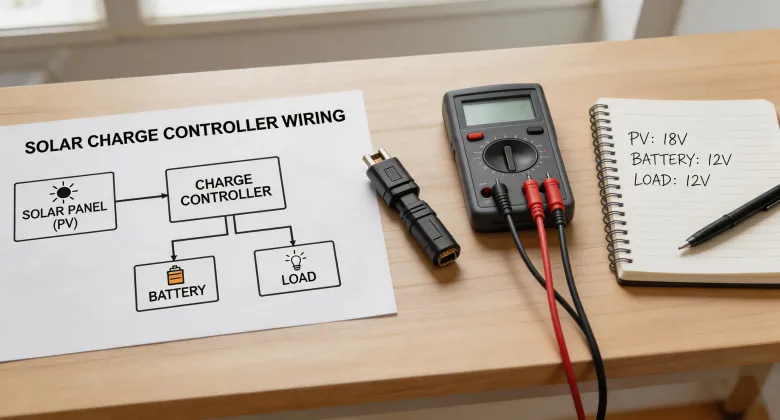
Last March, I was standing in a dusty equipment room on a sheep station about 90 minutes from Adelaide, looking at a solar charge controller that had just stopped working. It wasn't a Morningstar unit—I want to make that clear from the start. It was a "budget-friendly" alternative we'd installed on a solar energy storage project a few months earlier, and it had failed exactly the way budget products tend to fail: at the worst possible moment, with the client watching.
The station owner didn't yell. That was almost worse. She just asked, quietly, "So what's the plan?"
I didn't have a good answer.
How I Ended Up in That Equipment Room
I'm the office administrator for a mid-sized solar installation company in South Australia. I manage all our ordering—roughly $180,000 a year across panels, batteries, inverters, charge controllers, and mounting hardware. The job sounds simple: get the right equipment to our project teams on time and on budget.
When I took over purchasing in 2020, I assumed the lowest quote was the best quote. That's the classic rookie mistake, and I made it with total confidence. Unit price feels objective. It's a number you can compare across vendors, put on a spreadsheet, and justify to finance. Total cost of ownership requires you to estimate things like failure risk and rework time—vague and uncomfortable. So I defaulted to what I could measure.
The Cheap Controller Experiment
In late 2023, a new vendor approached us with MPPT controllers at nearly half the price of the Morningstar products we usually specified. Our project manager was intrigued. We had a solar energy storage Adelaide project coming up—a remote property with a microgrid expected to handle growing load—and the pressure to reduce costs was real.
I did what I thought was a reasonable comparison. The specs looked close on paper. MPPT efficiency was similar. Input voltage range was acceptable. The vendor said delivery would take two weeks. Did I believe them? Not entirely. But they actually delivered on time. So far, so good.
We ordered 14 units. The paper savings versus Morningstar: about $4,200.
That's when the experiment started to unravel.
Three Costs I Didn't Put on the Spreadsheet
First, the communication gap. I said "must handle a 48V bank with occasional 100A surge loads." The vendor heard "standard MPPT controller, fine." We discovered the mismatch three weeks later, after two site visits and a series of over-current alarms. The controllers were undersized for the client's actual load profile.
Second, the monitoring gap. Our maintenance team depends on live telemetry to maintain a current solar system map of every installation we service. The cheap controllers couldn't report data reliably. The client's battery bank dropped into over-discharge, and we didn't know until a week later when the backup generator kicked on and someone finally checked.
Third, the opportunity gap. The property owner asked a question that should have been an easy yes: "Can you charge an electric car with a solar generator?" She was thinking about buying an electric ute. With a properly sized system—a good MPPT controller, sufficient battery storage, the right inverter—the answer would have been "yes, comfortably." With the undersized controllers we installed, the answer was "not yet." That's not a hypothetical. That's a sale we gave the next installer.
What I Noticed After Switching Back to Morningstar
Here's a detail I wish I'd checked much earlier: the Morningstar logo. It sounds minor, but it tells you something about what you're actually installing. When we substituted a genuine Morningstar TriStar MPPT for comparison, the differences were obvious—heat sink design, terminal quality, labeling, the way the unit handled the 45-degree days we get in South Australia. The cheap units looked similar in photos but weren't built for unattended off-grid service.
Look, I'm not saying every cheaper controller is junk. They might be perfectly fine for a caravan or a weekend cabin where someone can physically check the system. For commercial and agricultural customers who expect the system to run for months without attention? Different story.
The Real Cost of That Experiment
Let me walk through the final numbers, because this is the part that changed how I buy:
- Upfront "savings": $4,200
- Replacements: $6,300 for 14 genuine Morningstar units (we couldn't trust the cheap ones after two failures)
- Extra site visits and labor: roughly $1,050
- Client downtime: 6 days without full solar output, worth approximately $900 in avoided energy costs at that site
- Reputation damage and recovery meetings: impossible to price, but two uncomfortable conversations with the client and one heated internal review
The $4,200 we saved became roughly $8,000 in real costs. Don't hold me to the exact cents—I'm working from memory—but the order of magnitude is right.
The TCO Framework I Use Now
I now calculate total cost of ownership before comparing any vendor quotes. The shorthand:
TCO = unit price + installation time + monitoring capability + failure risk + rework cost
If a vendor can't explain their failure rate, or their product doesn't feed data into the systems our team relies on, that's a red flag. The time cost alone can wipe out any price advantage.
This framework worked for us, but our situation is specific: a mid-sized installer in South Australia with predictable ordering patterns and a maintenance team that needs telemetry. If you're a DIY off-grid owner who enjoys tinkering, the calculus might be different. I can only speak to what I've seen in commercial and agricultural projects.
How We Buy Now
These days, we standardize on Morningstar products for almost all off-grid installations. The advanced MPPT technology does what the datasheet says, the remote monitoring feeds our current solar system map without manual data entry, and the reliability record means fewer emergency calls on my budget. According to the Clean Energy Council (cleanenergycouncil.org.au), component quality and proper system design are what separate reliable off-grid installations from chronic problems. That aligns with what we see in the field.
And the electric car question? We've quoted three solar-plus-storage systems this year where clients specifically wanted EV charging capability. With the right system design—a Morningstar charge controller managing the battery bank, adequate storage, and a proper inverter—the answer is genuinely yes, you can charge an electric car with a solar generator. The key is sizing it correctly from the start.
That's the difference between buying equipment and designing a system.
What I'd Tell Another Buyer
If you're in a similar role—purchasing solar equipment, managing vendors, trying to protect a budget—here are the four things I wish I'd known:
- Verify the brand before you buy. If you're specifying Morningstar, check the logo, the serial number, and the authorized distributor list. Gray-market units exist, and they don't perform like the real thing.
- Put monitoring on your cost sheet. A controller that can't report data isn't cheap. It's invisible. You won't know it failed until the client calls.
- Ask about surge handling, not just MPPT efficiency. A fridge starting at 3 a.m. doesn't care about peak efficiency percentages.
- Plan for the next question. When a client asks whether they can charge an electric car from their solar system, you want the answer to be yes—or at least a credible roadmap to get there.
We "saved" $4,200 and it cost us about $8,000, a month of internal headaches, and a small piece of a client's trust. I'm not 100% sure of the exact final figure, but I'm completely sure of the lesson: in solar procurement, the lowest price is rarely the cheapest option.
Take it from someone who learned that lesson the hard way, in a dusty equipment room outside Adelaide.