-
What is an off-grid solar system?
-
What does a Morningstar solar charge controller do?
-
Where is the Morningstar download center?
-
Can I run charge controllers or inverters in parallel?
-
What should I look for in an MPPT charge controller manual?
-
Is MPPT really worth it over PWM?
-
How do I monitor an off-grid system remotely?
Last month, an installer called at 4:30 on a Friday. A telecom site had gone dark, the client was losing revenue, and a replacement controller needed to ship within hours. We made it happen. But the conversation felt familiar—I've handled 300+ calls like it in the last four years, and the same questions come up every single time.
So here's the FAQ I'd hand to every installer before the first project. Whether you're trying to figure out what is an off grid solar system, comparing MPPT charge controllers, or getting ready to download the manuals and software you need, these are the answers I end up giving most.
What is an off-grid solar system?
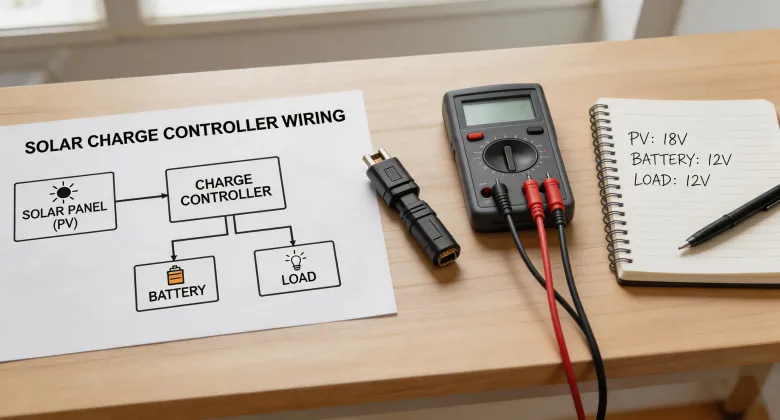
An off-grid solar system is a standalone power setup. No utility connection. Solar panels generate DC, a charge controller regulates it, batteries store it, and an inverter converts it to AC for regular loads. That's it. You generate, store, and manage your own power.
The charge controller is the component that protects your battery bank. Sized or programmed wrong, batteries get undercharged, overcharged, or ruined. Based on the failed systems we get called in to fix, controller issues are the #1 cause of premature battery death at off-grid sites. I don't have hard data on the industry-wide rate, but the pattern from 300+ site calls is hard to ignore.
One more note: if you're marketing a site as "renewable" or "green," keep your substantiation ready. Per the FTC Green Guides (16 CFR Part 260, ftc.gov/green-guides), environmental claims must be truthful and backed by evidence. A well-designed off-grid system is a measurable claim. Just be ready to show the numbers.
What does a Morningstar solar charge controller do?
Three things: it matches the solar array's output to the battery bank, stops charging when batteries are full, and disconnects loads before the battery drains dangerously low.
Installers spec Morningstar solar charge controllers for one reason: they keep working. The TriStar MPPT line runs 24/7 in remote telecom cabinets, off-grid homes, and industrial sites. We have clients with TriStar units in service since 2019 that have never needed a single maintenance visit. Period.
If you're comparing a solar charge controller by unit price alone, stop. Compare the total cost instead: replacement unit, plus service call, plus client downtime. A $200 price gap disappears fast when a cheaper controller fails at a remote site and the truck roll costs $3,000.
Where is the Morningstar download center?
morningstarcorp.com has a download section with every manual, datasheet, firmware update, and software tool. The two pieces of software most installers need are MSView for desktop monitoring and configuration, and MeterHub for multi-device management.
Field tip: download the manual and read the programming section before you arrive at the job site. Not during installation. Before. The calls we solve in 15 minutes are the ones where the installer has the manual open while programming. The hour-long calls are the ones where someone tries to program from memory. Don't be that caller.
Can I run charge controllers or inverters in parallel?
Two separate questions that get mixed up all the time.
Multiple charge controllers on one battery bank: yes, this works. Split the array into sub-arrays, each with its own controller. It's a common expansion path and handles arrays with different panel tilts or orientations. Use matching controller models, keep firmware aligned, and configure battery sensing properly.
Inverters in parallel: also yes for some products. Morningstar's SureSine line supports parallel configuration for higher AC output. But a solar inverter parallel connection is not universal across brands—some inverter designs simply can't do it. Read the manufacturer's documentation before you build a system around parallel units.
I'll be honest about my limits: my experience is mostly with off-grid residential and telecom sites. If you're working on a large hybrid project that needs AC coupling with a specific grid-tie inverter, the inverter manufacturer's engineering team is the right authority. Know where your expertise ends. That's not a weakness—it's what keeps projects from failing.
What should I look for in an MPPT charge controller manual?
If you're here because you searched for a "Rover 40A MPPT charge controller manual" or similar, welcome. Comparing controllers from different brands is exactly when the manual matters more than the spec sheet.
Open any MPPT manual and check these five things before you spec:
- Maximum PV input voltage. Cold weather raises panel voltage. Exceeding this rating can destroy the controller.
- Charge current at operating temperature. Some controllers derate at 40°C or 50°C—what you get in a hot enclosure isn't the spec-sheet number.
- Battery compatibility: 12V, 24V, 48V, and lithium charge profiles.
- Terminal size and wiring requirements. This changes your entire BOM.
- Monitoring and communication options: Ethernet, Wi-Fi, serial, etc.
It's tempting to think all MPPT controllers behave the same. They don't. Different algorithms, different cold-weather response, different charging profiles. Read the manuals side by side before you commit.
Is MPPT really worth it over PWM?
Look, it depends. I know that's not a satisfying answer, but it's the honest one. For small systems under 200W in warm climates with a 12V battery, PWM is fine and cheaper.
But the "PWM is always enough" line is an oversimplification. MPPT extracts more energy from the same array, especially in cold weather and with higher-voltage panels. We've measured 20–30% more harvest in the right conditions. That translates directly into generator fuel saved or usable power gained.
Example: a client in Montana with a 2kW array on PWM. Batteries were chronically undercharged in winter, so the generator ran constantly. We swapped to an MPPT controller—same array, same batteries—and the generator ran about 40% less. The controller paid for itself in fuel within one season.
So the real answer is: run the numbers for your site. And if someone tells you PWM is "just as good" for every application, push back. It isn't.
How do I monitor an off-grid system remotely?
The question almost nobody asks early enough: how will you know something is wrong before the client calls you?
An off-grid site can run on battery for days after a controller fault. Then the generator kicks in. Then it fails. If no one is checking, the site can be offline for days before anyone notices. That turns a simple fault into a real emergency.
Morningstar Portal gives installers remote visibility into every connected site: charge status, battery voltage, fault conditions, and system history. Alerts go out by email or text. For a remote site, that visibility is the cheapest insurance you'll ever add to a proposal.
I learned this one the hard way. My first year, I didn't push monitoring on a client with a remote cabin. The site went offline for four days before anyone noticed. A freezer full of meat spoiled. That mistake changed how I quote every system since: monitoring goes on every proposal. No exceptions.