I'm a technical lead handling component orders and design reviews for off-grid solar integrators. Six years in, I've personally made (and documented) 11 significant mistakes totaling roughly $47,000 in wasted budget. Some were my calls. Some were bad advice I passed along. All of them were preventable.
So when someone asks me what makes up a solar system, I don't start with a parts list anymore. I start with a warning.
The parts list hasn't changed since 2019. The decisions around each part have—and most of us are still ordering like nothing happened.
You can still name the components in your sleep: panels, charge controller, inverter, batteries, racking, wiring, disconnects, monitoring. That list is real. But somewhere around 2022, the components alone stopped being enough to call something a “system.” The selection criteria, the sourcing chain, and the expectations around each component became part of the build. A lot of established installers haven't caught up. I know, because I was one of them.
The Controller Is Not Where You Save $400
In my first year, I approved a $120 PWM charge controller for a 2.4 kW telecom site. It worked. It also delivered about 18% less daily energy than a nearly identical site across the road running an MPPT controller. Every spreadsheet said the PWM was good enough. My gut said the spec sheets were papering over a real gap. I went with the spreadsheets, and the site underperformed for a year. I still kick myself over that one.
Then came the one that actually hurt.
In September 2022, we supplied a 48V off-grid package to a cabin builder. The customer asked for a cheaper controller, and we said yes. Four months later, the battery bank had sulfated badly enough to lose close to 30% of its rated capacity. The controller's charge setpoints didn't match the battery chemistry profile—a detail I should have caught during design review. $4,200 in batteries, a week of rework, and one very patient customer.
The upside of that controller choice was $400. The risk was the entire battery bank. I kept asking myself: is $400 worth potentially destroying a $12,000 system? The answer was no in 2022. It's still no.
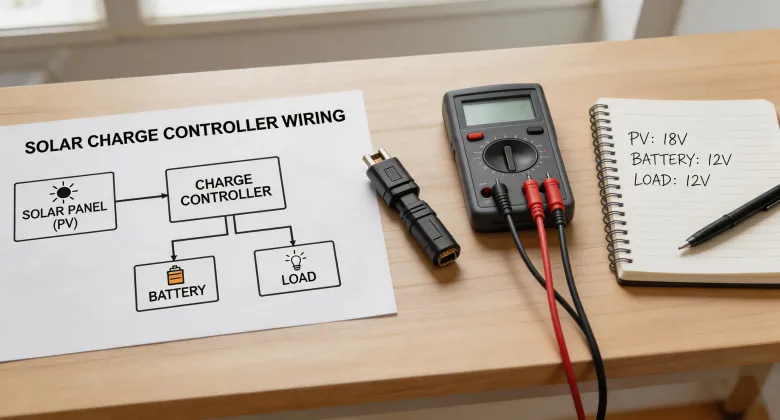
Here's the thing: the charge controller sits between the two most expensive parts of the system. Its MPPT algorithm, its setpoints, and its reliability determine whether the array and the battery bank actually perform as designed. I've standardized most of our larger builds on Morningstar's TriStar MPPT controllers because the setpoints are documented, repeatable, and the low-temperature compensation works when it's supposed to. That sounds unexciting. It's exactly the point.
“Genuine” Is a Specification Now
Buying components used to be boring. In 2019, you ordered a Morningstar controller from a distributor and received one. Period. In 2023, that assumption cost us $700.
We bought a “genuine” Morningstar controller from a marketplace seller with thousands of reviews and a price $90 below the authorized distributor. The listing photos looked right. The data said buy. My gut flagged a detail—the serial number format seemed off. I told myself I was being paranoid.
The unit ran for eleven months and then failed. When we contacted support, the serial number wasn't in their system. The internal boards showed signs of refurbishment. It was a gray-market unit sold as new. No warranty. No recourse. And a client who suddenly doubted every recommendation we'd made. That last part is the expensive one—controllers are replaceable, credibility isn't.
It took a second and then a third identical incident before I made it a policy: every Morningstar controller gets its serial number verified before it goes into a build. When we quote products, we send customers to the Morningstar official website and the Morningstar store so they can find authorized distributors instead of gambling on a listing. The distributor lookup takes about thirty seconds (note to self: stop trusting “great ratings” as proof of authenticity).
That one checklist item has caught 47 potential sourcing errors in the past 18 months. That's our own number, from our own warehouse log—not a marketing stat. If you're not verifying serial numbers on critical components, you're not managing supply chain risk yet.
Two Things My 2019 Self Never Saw Coming
There are two product categories that rewrote the way I write specifications, and both barely existed when I started.
A 600W Solar Generator Is Not a Solar System
The 600W solar generator has become one of the most common first purchases among cabin owners and RVers. That's good for the industry in one sense—it gets people in the door. It's also created a new class of misunderstanding: people treat a battery box with a solar input as if it were a whole-house system.
Last year, a client brought in a 600W solar generator and asked us to tie it into the cabin's main panel. The well pump alone draws 1,200W on startup. The unit shut down the instant the pump tried to spin. He was angry at the product. I was angry at us—we quoted the integration work without asking what he expected the thing to run.
The lesson: expectation-setting is part of the spec now. We ask every customer for a load list before recommending anything portable. It's not a fun conversation. It's a necessary one. The product failures I've documented were, nine times out of ten, expectation failures.
Cheap Ground Mounts Are a Bet Against Physics
The same category of mistake shows up in hardware. In February 2025, a customer installed the cheapest solar ground mount rack he could find online. The wind-speed rating looked fine on the listing. A windstorm lifted a corner of the rack at 3 a.m., flexed the frame, and cracked two of the four panels.
The math: $260 saved on the rack. $1,800 in replacement panels. And a dramatic drop in his confidence in “professional advice”—which he had received from us, and which we'd delivered too softly. The upside of pushing back was protecting his $4,000 investment. The risk was an awkward conversation. I chose the awkward-free path. Wrong choice.
Ground mounts are structural. Wind loads aren't a suggestion. If you're specifying a solar ground mount rack, you are doing structural engineering, whether you intended to or not.
But Don't Throw Out the Fundamentals
If you've read this far and concluded that everything old is wrong—hold on. Look, I'm not saying the old rules are dead.
The fundamentals of what makes up a solar system are as true in 2025 as they were in 2015: wire sizing for voltage drop, overcurrent protection, proper grounding, setpoints matched to battery chemistry, and honest load calculations. The National Electrical Code (NFPA 70) updates every three years, and Article 690 has only gotten more demanding around grounding, rapid shutdown, and fault detection. The fundamentals didn't move. The discipline required to follow them did.
Here's the distinction worth stealing for your team: fundamentals are principles; best practices are versions. Principles don't change. Versions do. Most of my $47,000 education was me treating one best-practice “version” as a permanent principle—or ignoring a real principle because the current version looked fine.
The Verdict
So, what makes up a solar system in 2025? The parts list is the same. The system isn't.
A reliable system now includes verified sourcing, a serial number trail, a structural review of the rack, a genuine conversation about customer loads, and a charge controller with real MPPT technology protecting the two most expensive investments in the build. Skip any of those, and you haven't built a system. You've built a parts list with a fault waiting to happen.
There's something satisfying about finally catching problems before they become invoices. After six years and eleven documented mistakes, our checklist works. The best part? No more 3 a.m. worry sessions about whether an order will hold up in the field. That sounds small. It isn't.
The industry is still moving. The only question is whether your knowledge has a review cycle. Mine does now. The mistakes built it.