-
The four categories, briefly
-
Scenario A: You need portable power for devices and small appliances
-
Scenario B: You need to run high-draw equipment from your vehicle
-
Scenario C: You need household backup or off-grid capability
-
Scenario D: You're sizing an industrial or commercial installation
-
How to figure out which one you are
Every few weeks, someone forwards me a product page and asks, "Is this the right one?" And every time, I give the same answer: I don't know yet. I need to know what you're actually trying to run.
I've been managing our operations budget—which includes backup and portable power for field crews—for about six years now. In that time, I've signed off on purchases ranging from a $300 portable station to a $14,000 rack-mounted lithium bank. And I've made enough expensive mistakes to know that the product category matters less than the use case.
So here's how I break it down when someone asks me to approve a power purchase. Four scenarios. Pick the one that sounds like you—and I'll tell you where the hidden costs usually hide.
The four categories, briefly
Before the scenarios, a quick taxonomy. Portable power stations (the EcoFlow Delta 3 Classic sits here—roughly 1,000–1,500 Wh capacity, carry-on size). Car inverters (12V DC to AC, the 3000-watt power inverter for a car being the high end of "casual use"). Solar generators (a portable station plus folding panels—yes, they exist, more on that below). And industrial lithium systems, where CATL lithium battery modules and LFP cells live. That last one is not a consumer purchase.
What I've noticed: people tend to treat these as a ladder—start small, upgrade later. That's usually wrong. Upgrading costs more than buying right the first time, mainly because you outgrow the input side (charging speed and capacity) before you outgrow the output side (what you can run).
Scenario A: You need portable power for devices and small appliances
This is the EcoFlow Delta 3 Classic territory. You're charging laptops, phones, a small fridge maybe, running a fan or a CPAP. Camping, tailgating, short-term outages.
The sticker price on something like this is usually around $900–1,200 depending on the bundle, based on publicly listed prices I've seen this year. But the number that got me was the charging time. I bought a 1,000 Wh unit for a field crew, thinking they'd recharge it from the truck's 12V outlet between sites. Didn't verify the input rate. Turned out the 12V charge was slow enough—I want to say about 8 hours for a full charge, though I might be misremembering the exact figure—that they'd burn through the battery faster than they could recharge it.
What I mean is that the headline capacity number is only half the story. The other half is: how fast can you refill it, and from what source? If you're not near an outlet, you'll want solar input, which adds $200–400 for panels and another hour of setup each time.
Looking back, I should have paid more attention to the input specs. At the time, I was comparing capacity and output wattage—the two numbers on the front of the box.
Scenario B: You need to run high-draw equipment from your vehicle
The 3000 watt power inverter for car use is a different animal. You're running power tools, a microwave, maybe a small air compressor. The inverter itself is cheap—$250–500 for a decent pure sine wave unit.
The hidden cost is everything around it. Wiring for 3,000 watts is not the same as wiring for a phone charger. You're looking at thick gauge cable, a fuse block, and—critically—a battery that can actually sustain that draw. Most stock vehicle batteries will drop below the inverter's low-voltage cutoff under a sustained 2,000-watt load, which means you need to upgrade the battery or add a second one. That's another $150–400 depending on what you drive.
Here's the assumption that bit me: I assumed a 3,000-watt inverter could run 3,000 watts continuously. It can't—not on a standard 12V system, anyway. Most units in this class are rated for peak power for a few seconds. Continuous output is usually 60–80% of the peak rating, and I'd have to check the specific model's datasheet to give you an exact number.
To be fair, the inverter manufacturers do disclose this. It's on the spec sheet. I just didn't read past the big number.
Scenario C: You need household backup or off-grid capability
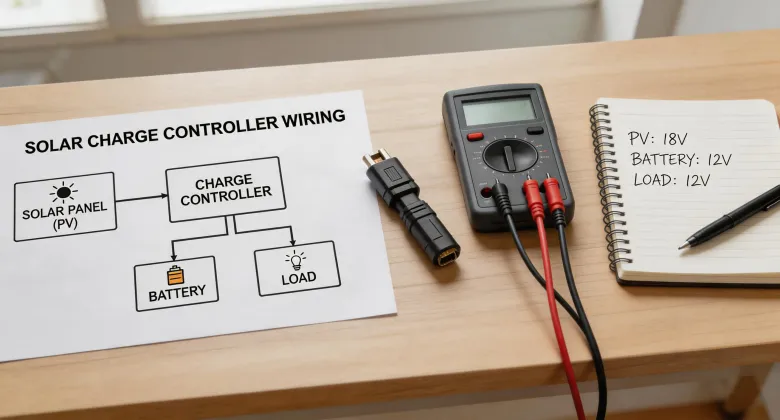
First, to answer the question directly: yes, solar generators exist. But the name is misleading. It's not a generator in the mechanical sense—it's a battery bank with a solar charge controller and an AC inverter built in. No moving parts, no fuel. Prices for a setup that can meaningfully cover a fridge, lights, and internet for a day run roughly $1,500–2,500.
The hidden cost here is the gap between rated solar input and actual solar input. A panel rated at 400W will produce 400W only under ideal conditions—direct sun, correct angle, cool temperature. In practice, on a partly cloudy day, you're likely getting 50–70% of that. In winter, with a low sun angle and shorter days, it's worse.
I've seen people buy a solar generator sized to their daily usage, then discover it can't recharge in a day during December. The fix is either more panels (more money) or a bigger battery (more money). Neither is cheap.
Granted, for true emergencies—a few days of outage—most of these systems will get you through. But if you're planning on regular off-grid use, double the solar capacity you think you need. That's not a marketing pitch; it's the correction factor I use after two winters of field data.
Scenario D: You're sizing an industrial or commercial installation
This is where CATL and similar industrial-scale lithium battery systems come in. If you're looking at a commercial backup system, a microgrid, or fleet-scale charging infrastructure, the math is entirely different—and TCO is the only number that matters.
The CATL lithium battery systems I've reviewed for our larger facilities are priced per kWh, plus balance-of-system costs (BMS, thermal management, enclosure, installation). Publicly reported cell prices have been trending down, though I'd want to pull the latest figure before quoting one—the range I've seen most recently was in the low hundreds per kWh for LFP cells at utility scale, but that's cell-level, not installed system cost.
What I watch for here is cycle life and degradation curve. A system rated at 6,000 cycles to 80% capacity means something different than a system rated at 4,000 cycles, even if the upfront cost per kWh is higher. Doing that math—cost per available kWh over the system's life—is the only way I've found to compare bids fairly.
CATL's sodium-ion and solid-state announcements are relevant here, not because I'm buying them today, but because they affect the resale value and replacement timeline of LFP systems I'm buying now. It's the reason we've been shortening our depreciation schedules on battery assets, from 10 years down to 7. That's a judgment call, not a certainty—but it's the call I'm making.
How to figure out which one you are
Forget the spec sheets for a second. Answer four questions:
- What are you powering? List every device and its wattage. If the total is under 1,500W and you can carry the system with one hand, you're Scenario A.
- Where is the power coming from? If it's a vehicle, you're Scenario B. If it's a wall outlet or solar panels in a fixed location, you're C or D.
- How long does it need to run? Hours = portable. Days = solar generator with panels. Weeks or continuous = industrial.
- What happens if it fails? Convenience = A or B. Safety or business continuity = C or D.
And the thing I wish someone had told me six years ago: spend 30 minutes on the load calculation before you spend 3 hours on product research. Most of the mistakes I've described here were preventable with a simple spreadsheet listing wattage, hours of use, and charging source.
Five minutes of math beats five days of return shipping. I've tested that theory more times than I'd like to admit.