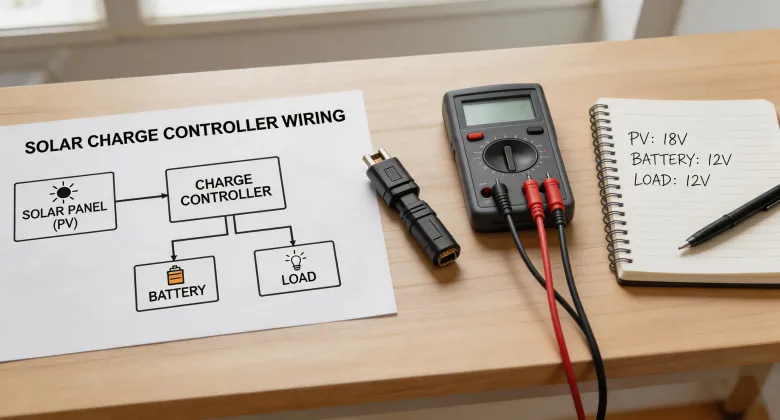
I'm a quality compliance manager at a renewable energy equipment distributor. I review every system design and product batch before it reaches customers—roughly 300 items a year. In Q1 2024, I rejected 11% of first submissions, mostly due to undersized charge controllers or incorrect battery voltage configurations.
One submission in late March still stands out. A regional installer we'd worked with for two years sent in a design package with two projects: a remote water-quality monitoring station with a 200W PV array on a 24V battery bank, plus a home retrofit where the homeowner wanted to pair a Tesla Powerwall with generator backup.
Attached to the package were three questions:
- 'What's the best solar generator?'
- 'What size charge controller for a 200W solar panel?'
- 'Can a Tesla Powerwall charge from a generator?'
They seemed unrelated. They weren't. Those three questions turned a straightforward order into a three-week delay and roughly $2,800 in avoidable cost.
The Sizing Question That Wasn't Simple
The 200W array should've been the easy part. 200W ÷ 24V battery bank = 8.3A nominal. So a 10A charge controller looks fine. Honestly, that was my first instinct too. I almost approved it. The math works—until it doesn't.
What that math ignores is the panel side of the system. The installer had selected a 72-cell panel with a Voc of 45.2V at 25°C. On a cold Michigan morning at -10°C, Voc rises roughly 10%—that puts the panel near 50V. The PWM controller they'd ordered had a max input voltage of 25V.
That's not a gray area. That's a 25V mismatch. I flagged the design and asked for a substitution.
The installer pushed back. 'The math works,' their project manager said. 'It's a 200W panel on a 24V system. What's the issue?'
The issue is that a controller rated for 25V max input can't absorb a 50V input from the panel. It would fail—probably on the first full-sun morning after the coldest night of the year.
We ran a bench test to prove it. At 22°C on the bench, the controller held 8.1A output. Within spec. Then we switched to a full-size 200W panel under real sun at 32°C. Input voltage hit 24.8V and the controller throttled output to 4.9A. That's a 40% loss. And 24.8V on a component rated at 25V max isn't 'working fine.' It's one thermal event from failure.
Per NEC 690.8, conductors and overcurrent protection have to be sized for 125% of the calculated maximum current. The same discipline applies to charge controller selection. You don't size for the nominal operating point. You size for the worst-case input: coldest temperature, highest irradiance, full battery. Any controller that's 'just enough' on average will be too small in the worst case.
That bench test was the turning point. The project manager went quiet for a minute, then said, 'Okay. What do you recommend?'
We specified the Morningstar TriStar MPPT 150/45. It's more capacity than a single 200W array needs—but the installer was standardizing their small off-grid fleet anyway, and the headroom meant they could scale the monitoring station later without re-spec'ing the controller. Thirty minutes of datasheet review and the design was approved.
The Fix: TriStar MPPT and the Morningstar Login App
The original design didn't include any remote monitoring. Nobody wanted to pay for telemetry on a water-quality station. After the TriStar MPPT swap, we set up the Morningstar login app—the free Portal app that connects the controller to a web dashboard. It took about 15 minutes.
That decision paid off six weeks later. The site's battery voltage started dipping below the charge setpoint every few nights, and the Portal app flagged an over-voltage event on the PV input. A subcontractor had swapped in a higher-voltage panel without updating the controller configuration. The monitoring caught it from 200 miles away before the controller could be damaged.
I don't think that station would have survived the summer without it.
The 'Best Solar Generator' Question
The same project manager asked about portable power for their field crews. 'What's the best solar generator?' The phrase is everywhere now, and I get why—there are dozens of all-in-one units on the market.
But from a quality perspective, the question is inverted. You don't pick a solar generator first. You define the load, the run time, and the recharge scenario. Then you pick the battery capacity, and only then do you match the panel and charge controller to the recharge window.
For most field-crew use cases, I'd rather size a small lithium battery bank, a Morningstar charge controller, and a folding panel array as separate components than buy a sealed all-in-one unit. Why? Because you can replace one failing component without throwing away the whole system.
I'll admit, that's the quality inspector in me talking. Sealed consumer units are fine for camping. But when a crew depends on the system for a 10-day outage response, modularity matters more than a tidy form factor.
Can a Tesla Powerwall Charge from a Generator?
Yes—with the right configuration. The Powerwall Gateway is designed to accept generator input for charging during prolonged outages. But 'right configuration' is doing a lot of work in that sentence.
Here's what has to be true:
- The generator has to provide stable frequency. The Gateway is picky. If output wanders outside its tolerance, it will reject the charging source. Inverter generators are typically fine. Open-frame conventional generators often aren't.
- The generator has to be sized for the charging load plus the house loads. A 5kW generator trying to charge a Powerwall while powering a well pump is going to struggle.
- The transfer switching has to be installed so the generator and grid never connect. That's a code requirement, and it's a serious safety issue for utility crews.
The homeowner's existing generator was an open-frame portable unit with messy output. We went with an inverter-grade replacement. It cost more, but it removed the frequency-drift failure mode entirely.
(Should mention: the homeowner was willing to upgrade the generator. If they hadn't been, we would've had to redesign the whole scenario with a manual transfer procedure. That conversation changes everything.)
The Lesson
The whole episode cost the installer three weeks and $2,800 in expedited freight and project delays. The root cause wasn't the wrong PWM controller. It was a set of questions asked in good faith without the context to know which specs mattered.
I'm not a fan of 'educate your customers' as a slogan—it comes off condescending more often than not. But an informed customer asks better questions and makes faster decisions. The installer could have called us on day one with the panel model number and battery voltage, and we would've said the controller's max input voltage matters more than its output current rating. That's a 10-minute conversation that saves a three-week delay.
A few things I tell every installer now:
- For charge controller sizing, the panel's Voc and temperature coefficient matter more than the panel's wattage. Wattage tells you how much power the panel makes under ideal conditions. Voc tells you whether your controller will survive real conditions.
- For a 200W panel on a 24V battery bank, a controller with at least 30A capacity and a 150V max input rating gives you real headroom. That's the NEC 690.8 worst-case-sizing discipline in practice.
- The best solar generator is the one sized from the load backward, not from a product catalog forward.
- For Tesla Powerwall generator charging, verify the Gateway configuration, confirm the generator's frequency stability, and have a licensed electrician handle the transfer switching. Don't let anyone wire around the interlock.
At the end of the day, my job is to catch problems before they become projects. The TriStar MPPT swap had a good outcome, and the Portal app gave the installer visibility they didn't have before. But the cheapest fix is still the first design review—done before the purchase order goes out, not after the field test fails.
I should add: this approach worked for us because we're a mid-size distributor with controlled order flow and a direct line to our customers' project managers. If you're a one-person shop selling through dealers, you might not be able to catch every design error at the counter. That said, the core principle—size for worst-case input, not average-case math—applies no matter how you sell.
If you're designing an off-grid system and you're not sure your charge controller can handle your coldest morning and your largest panel, send the specs to your distributor before you buy. The 15 minutes it takes to read a datasheet is a lot cheaper than the three weeks this type of mistake costs.