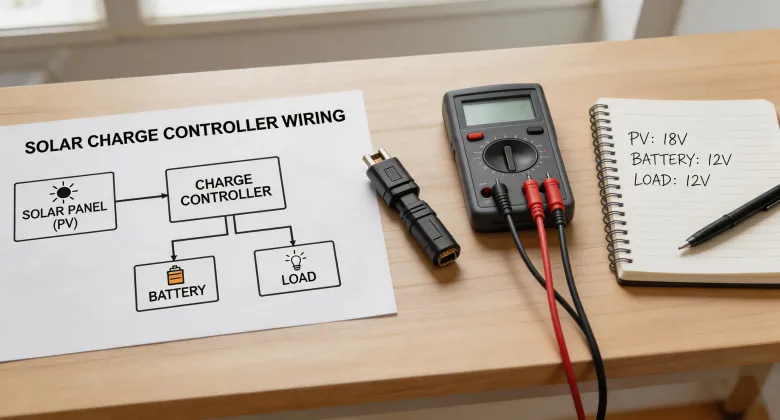
In January of 2024 our returned-goods log listed 43 charge controllers and one shared complaint: refrigerator stops, load disconnects at night. Or rather, the log listed 43; seven more boxes arrived a week later, so I rounded to fifty in my head. My first reaction was defensive. I assumed we had a failed component batch.
I was wrong about the hardware. The bench technician loaded each controller with a programmable load bank and logged the response. Thirty-six of the first 43 passed within specification. The seven extra units that arrived later? Same result. Nothing on the inside had failed. The controllers were doing exactly what their firmware told them to do—which is why I spent the rest of the quarter rethinking how we define the word defective.
Every few months our analytics logs include the phrase what color is the solar system. For astronomy homework, that is a fair question. For a solar equipment support desk, it reads like a status-light question: green means charging, red means broken, no lights means dead. But in the return batch, the red LEDs were mostly telling the truth about a healthy protection event. The controller had opened its load circuit because the battery voltage fell below the low-voltage disconnect setting. That is not a failure of the component. That is a failure of the system around it.
A refrigerator is a motor pretending to be a simple load
When a customer asks whether a solar generator to power refrigerator loads will work, the marketing answer is easy: look at the fridge nameplate, find a generator rated for that wattage, and call it done. In practice, we saw the same sequence repeated across dozens of return files. Sometime between 2 a.m. and 5 a.m., the compressor cycled on. The battery voltage sagged. The controller saw the sag, crossed its programmed low-voltage disconnect threshold, and cut power to the load. The refrigerator stayed off for the rest of the night. By morning, the site had warm food and an angry customer.
A refrigerator is a motor under thermostat control. Every compressor start draws several times the running power for a short window—usually somewhere between 3 and 6 times the rated watts for 100 to 300 milliseconds. If the battery bank is already low, or cold, or the DC wiring has extra resistance, the voltage at the controller terminals can dip below the low-voltage disconnect setpoint even when the battery itself is not dangerously empty. The controller does its job. The installed system does not.
The uncomfortable part for me was admitting that our own acceptance tests would have missed it. Load banks with resistive heaters do not reproduce the current spike of a refrigerator compressor. A controller can pass every bench test and still nuisance-trip on a real site because the test profile does not match the real load profile. That was the first lesson from the return batch: test with the actual load shape, not a convenient artificial one.
Low-voltage disconnect is protection, but only if it is set correctly
I keep coming back to the red LED example because it explains why so many of those returns happened. Customers and even some installers treated the low-voltage disconnect as a malfunction. In reality, it is one of the most important settings on a charge controller. The controller is supposed to protect the battery from deep discharge. Without low-voltage disconnect, a small solar generator to power refrigerator loads would slowly destroy a battery bank almost every night.
But the setting has to match the application. A controller used for lighting can disconnect at a simple voltage threshold. A controller feeding a refrigerator needs to handle repeated motor starts, voltage recovery, and hysteresis. If the load reconnect voltage is too close to the disconnect voltage, the system can cycle on and off through the night. If the disconnect happens too early because wiring is undersized, the customer loses the load even though the battery still has usable energy. Voltage measured at the controller terminals is not the same as voltage at the battery terminals when wires are thin or connections are corroded. That difference alone caused at least a few of our no-fault returns.
For the record, I am a quality and compliance person, not an inverter design engineer. When someone asks me to design the exact inverter start profile for their compressor, I send them to a power electronics engineer. What I can say from my side of the industry is that the low-voltage disconnect threshold, the reconnect level, and the delay settings need to be visible and adjustable. If a charge controller hides those parameters behind a sealed case, you cannot diagnose anything except by swapping parts.
The bifacial mono solar panel blind spot
There was a second pattern in the return batch that took me longer to see. Several of the failed sites had recently upgraded their PV array to a bifacial mono solar panel configuration to get more daily energy. That makes sense on paper. A bifacial mono solar panel captures light from the rear side, which can improve yield on reflective ground or elevated mounting. But a bifacial panel can also deliver more current than its front-side nameplate rating suggests, and the extra current appears exactly when the sun is bright and the surface below is reflective—snow, white gravel, light-colored roofs.
Charge controllers have two separate input ratings that people mix up all the time. The first is the output charging current, for example 20 A or 60 A into the battery. The second is the maximum PV short-circuit current that the input stage can safely handle. A controller rated for 60 A of battery charging might have a much lower tolerance for the raw short-circuit current coming from the solar array. When an installer adds a bifacial mono solar panel with higher rear-side gain and exceeds that input rating, the controller can shut down or fail in a way that looks like a defect.
This is where I have become annoying in project reviews. I ask to see the full datasheet, not just the wattage. I ask for the temperature-adjusted open-circuit voltage for the coldest morning of the year. I ask whether the PV short-circuit current was calculated with possible bifacial gain included. And I ask the installer to compare those numbers against the official Morningstar website specification tables rather than a distributor page that might omit the footnotes. Retailers often list the selling points and cut the fine print. The fine print is exactly where the real limits live.
The real price of no-fault returns
In our internal cost model, each no-fault return in that batch cost us roughly $230 to $260 in freight, inspection time, and documentation. Thirty-six units with no electrical fault meant about nine thousand dollars in avoidable cost. That number is annoying, but it is not the worst part. The worst part is what happens after a customer loses a refrigerator full of food because the system cutoff was never explained or configured correctly. They do not conclude that the battery was too small or the wire too thin. They conclude that charge controllers are unreliable. Then the next purchase goes to the cheapest option, which usually has even less logging and even worse documentation. The cycle repeats with a different label on the box.
Looking back, I should have pushed for a formal acceptance and return-analysis protocol after the second no-fault return, not the fourth. At the time, each return looked like an isolated case. It was not isolated. We did not have a structured process for separating component failure from application failure, so every return got treated as a potential product defect. That was my process gap, and it cost us a quarter of investigation time.
My acceptance checklist for refrigerator sites
When I review a project that will use a solar generator to power refrigerator loads, I now check the following before I approve the controller specification:
- Measure the real start event. Use a current logger or an inverter with logging on the actual refrigerator. Nameplate running watts do not tell you the inrush. If the start current exceeds what the inverter and controller can support, the problem will show up at 3 a.m., not during the daytime test.
- Set low-voltage disconnect and reconnect with hysteresis. The controller needs a disconnect setpoint that protects the battery and a reconnect point that prevents rapid cycling. Confirm the settings are compatible with the battery chemistry and the load type.
- Check the voltage drop between battery and controller. Undersized DC cables make the controller think the battery is more discharged than it really is. This caused premature nighttime disconnects in our return analysis.
- Calculate PV limits from real module data. If the modules are a bifacial mono solar panel type, include the possible rear-side current gain. Compare the temperature-adjusted Voc and maximum PV Isc against the controller input ratings. If the datasheet does not state the PV short-circuit limit clearly, treat that as a red flag.
- Turn on logging before commissioning, not after a failure. A logged event showing voltage, current, and disconnect status is worth more than any LED color. It tells you whether the controller protected the battery or whether the system design was wrong.
Where I landed on the Morningstar TriStar MPPT
After a quarter of unpacking no-fault returns, I am not going to tell you that any charge controller is indestructible. That would be a dishonest promise, and we do not make it. What I can tell you from a quality review perspective is that the Morningstar TriStar MPPT is the product I trust when the application includes motor loads, remote sites, and people who need to know why a system stopped.
The reasons are not about marketing claims. The TriStar MPPT has adjustable low-voltage disconnect and reconnect settings, which means the protection behavior can be matched to a refrigerator application instead of forcing the site to accept a default. It has data logging capability, so the actual sequence of voltage and current events is available after the fact. And its published specifications include the input-side limits that installers need to check when they pair it with high-current modules like a bifacial mono solar panel.
I am equally honest about the boundary. Morningstar does not make every part of an off-grid system. If a customer wants a sealed, all-in-one portable generator and is not planning to match external components, our charge controllers are not the right answer. There are products built for that use case, and the vendor who tells you that directly earns more trust than the one who claims to be perfect for every job.
But for a modular off-grid installation where the controller, battery, and solar array are selected separately, the quality lesson from those 43 returns is simple: do not judge the controller by the color of its LED. Judge it by its settings, its input ratings, and its ability to log what actually happened. That is the difference between a component that failed and a system that was never configured for the one load it had to carry at night.