-
The Surface Problem: Float Readings That Don't Fill the Battery
-
The Deeper Issue: Amp Ratings Hide the Voltage Story
-
The Difference Between 12v and 24v Solar System Designs Is More Than Wire Size
-
The Lithium-Ion Solar Energy Storage Market Made This More Complicated
-
What This Costs When You Skip the Voltage Spec
-
The Fix: Verify Before You Replace
An installer called me about a Morningstar charge controller he wanted to return. The controller read float by 2 p.m., but his new lithium battery was still at 27% by sundown. He had already ordered a replacement.
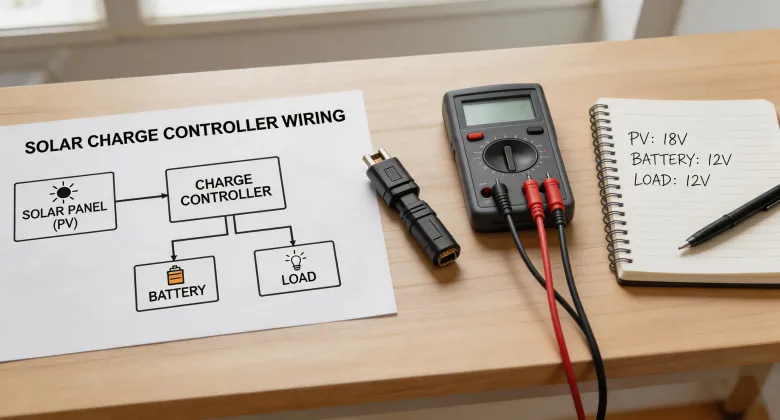
The replacement would not have helped. The controller was configured for a 24 V battery bank while the panels, inverter, and loads were wired for 12 V. It was not a hardware failure. It was a system-design failure wearing a controller label.
I review Morningstar charge controllers and related power equipment before it ships. In my role, I check every delivery—roughly 200+ items a year—against approved specifications. The most expensive problems do not get caught at my desk. They happen when someone builds a system from assumption.
The Surface Problem: Float Readings That Don't Fill the Battery
A charge controller is not an independent charger. It executes a charging profile based on the battery voltage and chemistry it is set to. If those settings do not match the actual bank, the controller can report normal float while the battery silently misses its absorption target. The controller is not lying. It is following the math it was told to follow.
What most people don't realize is that the status screen is not a battery monitor. 'Float' is a controller state, not a battery charge level. The battery could be at 50%, 27%, or anywhere in between.
The Deeper Issue: Amp Ratings Hide the Voltage Story
First spec check: a charge controller's output current rating does not translate into one fixed panel wattage number. On a 12 V system, the absorption voltage is around 14.4 V. A 30 A controller can therefore deliver roughly 430 W into the battery. On a 24 V system, the same 30 A controller can deliver about 860 W. Same part, bigger power flow—because the output current is fixed but the system voltage decides the actual power.
If you compare controllers by amps alone, you are comparing half the specification. The voltage side is where Morningstar publishes detailed limits. The Morningstar official website lists every controller's maximum PV watts by battery voltage. That page should be part of your initial design, not an afterthought.
The Difference Between 12v and 24v Solar System Designs Is More Than Wire Size
Ask ten installers to explain the difference between 12v and 24v solar system architecture and you will hear one confident sentence: 24 V lets you use thinner wire. That is true, but it misses the bigger point.
For the same power, 24 V halves the current. Current is what creates voltage drop and heat. But system voltage also changes how you size the solar charge controller and how many panels you can put in series.
- In a 12 V system, the PV array often has to stay below a lower voltage ceiling, especially on cold mornings when panel Voc rises.
- In a 24 V system, wiring two 12 V panels in series becomes normal. That uses the available voltage headroom in an MPPT controller more effectively.
- At 3,000 W on a 12 V bus, load current is around 250 A. That means large cables, expensive breakers, and noticeable losses. At 24 V, it is 125 A. Still large, but more manageable.
I am not saying 12 V is wrong. It makes sense for small mobile loads, vehicles, and tiny cabins. But 12 V is a choice, not a default. Choose it after calculating the real load, not before.
The Lithium-Ion Solar Energy Storage Market Made This More Complicated
Ten years ago, if a controller had good sealed lead-acid settings, it could work in most off-grid sites. The lithium ion solar energy storage market changed that.
Most new batteries I see in 2025 are LiFePO4. LiFePO4 cells do not want equalization charging, and many want different absorption and float windows than lead-acid. A BMS will disconnect a cell if voltage goes out of range. When that happens, the controller sees an open circuit and may try to restart. From the outside, the system looks like a controller failure. In reality, the battery is protecting itself from an inappropriate charging profile.
The key is that 'compatible with lithium' is not a yes/no checkbox. It means the controller must allow you to set or disable specific voltages. The same model might have one firmware version with a lithium profile and another with only lead-acid settings. If you assume they are identical, you are designing in a fault.
This is why I ask about the battery before I talk about brand names. The most common question I hear is whether a Morningstar charge controller can be added to a pre-assembled package like a Snaochat solar system. Yes, it can. But first I need the battery voltage and the BMS window. A controller cannot fix a package that was never designed as a real system.
What This Costs When You Skip the Voltage Spec
The first cost is time. A mismatch that looks like a failed charge controller can burn days of troubleshooting. You swap controllers, reset settings, call support, and then discover the problem is at the battery bus.
The second cost is battery life. Repeated voltage mismatch can keep a bank from reaching full charge or push it into BMS disconnect cycles. I have seen lithium batteries returned as bad when the controller was running an equalization schedule the battery was never designed to accept.
There is also the return process. In our 2024 warranty audit, I reviewed every 'defective' Morningstar controller that came back to us. More than half tested fine on the bench. The returned units showed configuration errors or site wiring problems—not failed electronics. I don't remember the exact percentage; I would have to check. But the pattern was unmistakable.
And don't dismiss this because the project is small. Some of the worst voltage mismatches I have seen were in starter systems. It hurts less to lose a little battery capacity in a test setup, but it hurts when that same design is replicated for a paying customer. Today's 12 V shed might be next year's 24 V rental property or 48 V home backup. The customers I treated seriously when their order was small are the ones who still call me now that their orders are bigger.
The Fix: Verify Before You Replace
If you are staring at a charge controller that seems to fail, slow down.
- Measure the actual battery voltage at the battery terminals, not at the controller.
- Open the battery datasheet and note absorption, float, and equalization limits. If the controller profile does not match, no controller in the world will make the battery work well.
- Go to the Morningstar official website and download the manual for your exact model. Check the battery-voltage selection and the PV input voltage limits against your array.
- If the battery has a BMS, confirm the charging profile with the BMS before committing to the install.
I keep the fix simple because the problem is usually simple too, just buried under assumptions. The controller is not the enemy. The voltage mismatch is.