Conclusion first: If your client asks for an efficient wind turbine to run a heat pump, the turbine is not the first component I would inspect. The system specification is. An air to air source heat pump can be a genuine match for wind power, especially in winter, when wind generation and heating load tend to line up. But if the charge path, battery, and heat pump are not designed as one system, the project will fail even though every individual component is good. I see that pattern in system documentation I review, and the cost of fixing it goes up dramatically once the hardware is mounted.
Buyers often ask which turbine has the highest efficiency, or which heat pump has the best coefficient of performance. Those are not the first questions I would ask. The better questions are: What happens when the battery is full on a windy night? What happens after three calm days in January? If a proposal cannot answer those two questions with actual calculations, the efficiency data is not enough to justify an installation.
Why I focus on the system, not the nameplate
I am a quality/compliance manager at Morningstar. We manufacture charge controllers and remote monitoring products for off-grid solar and renewable energy systems. We do not make turbines or heat pumps, which puts me in a useful position: I do not have a brand preference for any wind or heat pump equipment. My concern is whether the pieces can work together safely and predictably.
In 2024, I reviewed more than 200 system documents and returned units. The failures with the largest installation cost shared the same signature: the turbine was selected carefully, the heat pump was selected carefully, and the space between them—the charge controller, dump load, and battery—was treated as an afterthought.
What an efficient wind turbine actually proves
An efficient wind turbine is efficient at a particular wind speed. Most marketing materials show peak performance, not what happens at the average wind speed on the client's property. A turbine that looks strong at 11 m/s can deliver very little energy on a site with an annual average of 4 m/s.
When a customer talks about a “wind power plant for home,” the design is really a complete energy system: a small wind generator, battery storage, an inverter, and a charge control path with a safe way to dump excess power. That deserves the same documentation discipline as a utility-scale project. The same type of certificate and measured power curve that would be expected for a wind farm generator should be expected for a 1.5 kW home wind machine.
The heat pump is not a steady load
Residential heat pump systems are efficient because they move heat instead of creating it from resistance. But efficiency is not the same as a stable load. An air to air source heat pump changes its draw with outdoor temperature, compressor speed, and defrost cycles.
The common error I see is designing around a steady-state power number from the heat pump brochure. In cold weather, defrost cycles add load. If the system includes auxiliary resistance heat, the short-term draw can be much higher than the heat pump nominal rating. That draw must come from the battery and inverter, not from the wind turbine at the exact moment the wind happens to blow.
Four checks I would put into the project file
These are not product preferences. They are engineering checks I want to see before approving a wind plus heat pump design.
- Measured power curve and cut-in speed. The turbine's power curve should be based on a recognized method such as IEC 61400-2 for small wind turbines. The cut-in speed should be below the expected mean wind speed at the actual hub height. If the machine needs more wind to start than the site provides, the battery will start every morning lower than the design assumes.
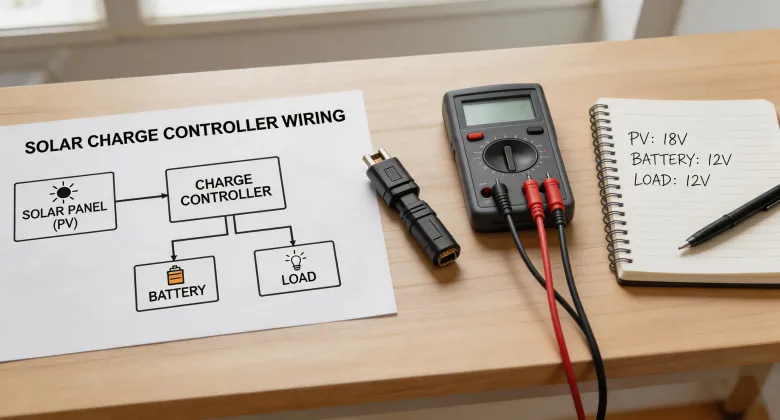
- Charge controller compatibility and dump load. A wind turbine must have a load when the battery is full. The design should include a controller with diversion/dump capability that can absorb the turbine's maximum output continuously. Without this, the turbine can overspeed and the battery can overcharge.
- Battery C-rate and inverter surge. kWh capacity is not enough. The inverter must survive the heat pump's cold-start and defrost current steps, and the battery must deliver current at the rate the inverter demands. Some heat pumps draw in a way that confuses generators and inverters that are sized only for average loads.
- Remote monitoring and alarms. Wind and heat pump systems behave differently in winter. The system should record battery voltage, turbine status, and heat pump runtime so the installer can see a developing problem before the homeowner has a cold house.
The rooftop windmill generator temptation
I understand why the idea of a rooftop windmill generator keeps appearing in residential plans. It removes the tower cost and makes the investment visible. But most roofs are not acceptable wind sites. The building and surrounding trees disturb the airflow, so the turbine starts late, runs in turbulence, and vibrates more than it would on a proper tower.
A rooftop windmill generator can work in rare cases—an unusually exposed building with an isolated roof and an engineered mounting system. For most houses, the energy output will be disappointing. The visual appeal is real. The physics are not.
When home wind still makes sense
To be fair, I have reviewed several good residential wind designs. They all had open sites, genuinely high average wind speed at hub height, and a heating load that peaks in winter. That seasonal match is the strongest argument for pairing wind with an air to air source heat pump: wind can produce when solar is weakest.
The cheapest option is also not always the cheapest to own. A rooftop windmill generator may have a lower initial price, but repeated service trips and poor winter output are real costs. I have learned to look at total installed cost and expected annual energy yield, not the equipment price alone.
Final caveat: I have not reviewed every wind and heat pump project, and some exceptions exist. But I would not approve any design that cannot explain what happens during a high-wind full-battery event and a long low-wind period. If the system file cannot show both, the efficiency promises should not carry the decision.