I get the calls most installers don't want to get: a system that's supposed to be live in two days, and something is dying at the wrong time. In April 2024, at 4:15 on a Thursday, I was on the phone with a contractor who had a weekend deadline and an off-grid site that wouldn't hold charge past 2 p.m. “The panels are clean, the batteries are new,” he said. “What else could it be?”
Maybe I should back up. In the last two quarters, I've triaged more than 40 rush system failures for off-grid sites. In the majority, the charge controller was either undersized, set up wrong, or just not up to the task.
The surface problem: the sun is out, and the batteries are dying anyway
If you've worked in this industry, you've heard the complaint. Customers see the solar array, they see the battery bank, and they assume the missing piece must be a better panel or a bigger battery. So they add solar modules, or they buy a larger inverter, or they replace everything except one component.
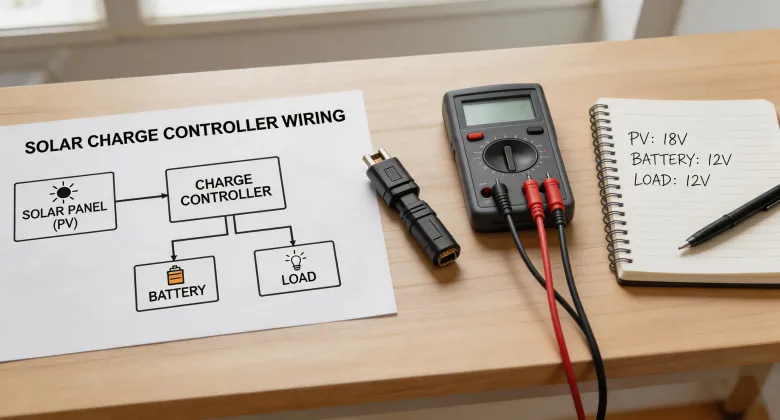
That missing piece is basically the brain between the array and the battery. The charge controller decides how much of the panel's energy gets stored, and whether the battery gets a proper charge cycle. When it's undersized, badly configured, or using a lossy charging algorithm, your system can lose a ton of energy before it ever reaches the battery.
Take the Renogy 600 watt solar kit as an example. It's a popular starting point for small sheds, RV builds, and backup power experiments. Nothing wrong with the approach. But if that kit ships with a PWM controller—or gets installed with one—you're leaving energy on the table in the morning, in the evening, and on cloudy days. An MPPT controller recovers some of that loss by converting excess voltage into usable current. PWM doesn't do that; it just throttles.
A lot of people think this is a minor efficiency detail. It's not. On a 600W array, the difference between PWM and MPPT can easily be a few hundred watt-hours per day in real conditions. On an off-grid phone site, that's the difference between staying up all night and dropping out at 7 p.m.
The deeper cause: most system designers treat the charge controller as an accessory
What most people don't realize is that the charge controller is not a generic component to be picked after the panels and batteries are selected. It's a decision with consequences that show up a year later, usually when you're standing on a ladder in the rain.
Here's the blind spot I see over and over: buyers focus on panel wattage and battery amp-hours, and completely miss the controller's PV input voltage rating, dynamic tracking, and charging algorithm. The question everyone asks is “How many watts?” The question they should ask is “What is the maximum PV input voltage, and does the controller have enough headroom for cold mornings?”
Cold weather makes solar panels produce higher voltage. A controller rated just barely above the nominal array voltage can be destroyed in one cold snap. This is a real failure mode, and it's why professional MPPT design specs include PV input current and voltage margin. The Morningstar Tristar MPPT has proper calculation tools and datasheets for this, which is one of the reasons we use it on sites with deadlines. But you still have to run the numbers.
And that brings up another topic that does not get enough attention: solar module testing equipment. Before you blame the controller, you should know exactly what the modules are producing. An I-V curve tracer or a good clamp meter with irradiance sensor will show you if a panel is damaged, shaded, or degraded. We've had projects where the controller was sent back under warranty and the real problem was a bad connector in the PV combiner.
So the deeper cause of a “mysterious” failure isn't usually one broken part. It's a design process that didn't put enough attention on the controller and the testing around it.
The cost: what a cheap controller really costs you
Let me do some rough math that's based on distributor pricing I've seen as of early 2025, not a formal quote. A 30A PWM controller might cost $120. A reliable 30A MPPT controller costs maybe $400 to $600 wholesale, depending on features and monitoring. The “savings” from PWM looks like $300 to $480.
Then the battery bank starts failing a year early. A decent off-grid battery bank is $1,200 to $2,500. Maybe you get two service calls at $150 each. Then a rush freight order because the site needs the right controller by Friday, and that's another $80. Now the $300 “savings” is a $2,000 problem.
This is the total cost of ownership math I always bring up. Unit price is only the first line. The real TCO includes installation time, service calls, battery lifespan, downtime, and the cost of sending someone back to a remote site. The cheapest controller is almost never the cheapest system.
Honestly, I still kick myself for a 2023 install where I didn't push for remote monitoring. The system had a local fault LED, which would have been fine if the site was in town. It was 140 miles round trip. A monitoring module and the Morningstar app would have shown the charge history and fault code in minutes. Instead, we burned a full day and a truck roll.
And if you're an installer or a system integrator, there's a second cost: your reputation. Every “cheap controller” callback puts your name on a list of vendors who might not get invited to the next job.
The fix: turn the design process upside down
The answer is not to buy the most expensive controller on every project. It's to make the controller one of the first decisions, not the last. When we design a system with a hard deadline, we choose the charge controller first, then compute how many panels the controller can actually handle and what battery charging profile it will run.
That's why we spec Morningstar Tristar MPPT on a lot of emergency-response installs. Not because it's flashy, but because the data on PV limits and temperature characteristics is real, and the logging lets us see what happened before we drive out to a site. The Morningstar app gives you generated energy history, battery voltage graphs, and fault records. In my role coordinating off-grid fixes, that remote visibility is the thing that turns a four-hour diagnosis into a fifteen-minute one.
For system builders, I'd add three habits:
- Use solar module testing equipment on every site visit. It pays for itself the first time you catch a mismatched string.
- Design with 25% to 30% headroom on PV input voltage, especially in cold climates. Check the controller's datasheet, not the marketing page.
- Set up remote monitoring before the site goes live, not after the problem appears.
One quick note on portable power stations, since people ask me about them all the time: if the question is “how to charge a Jackery solar generator?”, the answer is that the Jackery has its own internal charge controller and you use its rated solar input. You don't need an external MPPT for that. But the principle still applies: verify the panel's voltage falls inside the Jackery's input window before you connect it, and don't assume an 18V “12V” panel is always safe in cold sunlight. Same logic, different package.
The bottom line is simple. Off-grid systems fail for a lot of reasons, but the ones that bite hardest in an emergency share the same root cause: the charge controller wasn't taken seriously enough. Start there, do the math, and get visibility into what the system is doing. Because when a client calls at 4:15 and the site has to be live by Monday, the controller is not a small detail. It's the whole game.