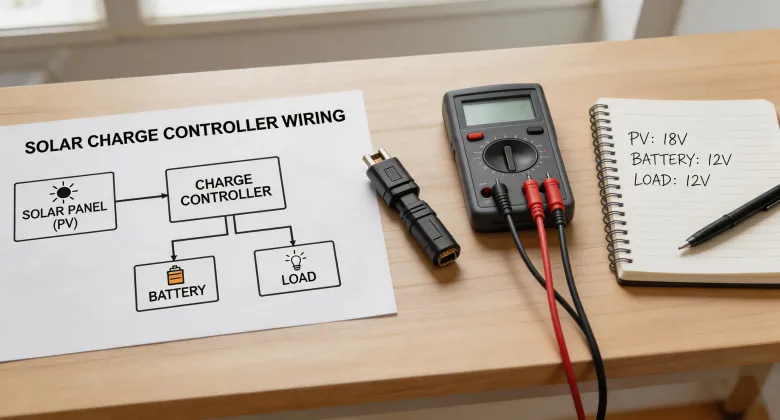
The phone rang at 6:10 a.m. on a Tuesday in November. A water district’s remote pump-telemetry station had gone silent. For me, a silent site usually means one of two things: a dead battery or a dead charge controller. On that trip, it was both — and the real problem was that the system had never been designed as a system at all.
I’m an applications engineer who has handled off-grid solar orders for nine years. I’ve personally made (and documented) 31 significant mistakes, and those mistakes cost roughly $63,000 in wasted budget and rework. I now maintain our crew’s pre-install checklist. This story is why one more item is on that list.
The Service Call
The cabinet sat beside a canal. The station charges a 24V battery bank from a PV array and uses that battery to power a radio that reports water levels every 15 minutes. Nothing exotic. I opened the cabinet and saw a controller whose label was designed to resemble the Morningstar logo. At first glance, it looked official. Then I looked closer: the font was different, the model number wasn't one I could find, and the serial number looked printed rather than punched. It was an imitation, and the pricing on the original purchase order made sense now.
The battery rested at 22.8V, which is too low for a nominal 24V bank. The PV array was producing voltage, but no charging current was reaching the battery. The failure was not one big event. It was a sequence. The previous controller had no remote monitoring, no temperature compensation, and none of the data needed to understand the battery state. It was also mounted so tightly against a cable tray that its heat sink had almost no airflow. A corroded fuseholder added resistance. Any one of those issues might have survived for a while. All of them together did not.
The safest fix was to replace the controller and start from a known baseline. The replacement I ordered was a genuine Morningstar solar controller, a TriStar MPPT 60A. It gave us a higher PV input limit for cold mornings, a port for remote monitoring, and a display that lets a local technician read fault codes without opening a laptop. I still sized the array carefully, but it felt better to work with a controller that was designed for this job instead of priced against it.
Before ordering, I did a step that should have happened when the original unit was received. I compared the old label with official product images. The old word was set in a bold font with extra spacing; the official one uses the Morningstar logo, and that logo is not printed like a cheap sticker. I now take a photo of every incoming controller nameplate and check it against the manufacturer’s published examples. This is not paranoia. It’s a ten-second task that stops a whole series of bad decisions.
What Makes Up a Solar System (and What Does Not)
Before I go further, I need to clear up a search term. If someone types 'snapchat solar system' into a browser, they are not looking for charge controllers. They are looking for Snapchat’s friend-placed planet display. That is not what I mean here. The question I ask on every site visit is: what makes up a solar system for an off-grid load that cannot shut down? Too often, the answer is a list of parts bought from different suppliers and connected together. That is missing the real answer.
What makes up a solar system for a remote industrial load is actually six pieces:
- PV array — the source. It must be sized for the worst month, not the annual average.
- Charge controller — the regulator. It decides the charging voltage and current based on battery temperature.
- Battery bank — the storage. It provides energy when the sun does not.
- Inverter or DC-DC converter — it makes the stored energy usable for the load.
- Disconnects and overcurrent protection — fuses, breakers, and proper cable sizes make fault finding safe.
- Monitoring — you need to see the system from somewhere other than inside the cabinet.
That word 'system' is the point. The original station had six parts, but there was no design logic connecting them. An imitation controller, an old battery, and a corroded fuseholder do not become a system simply because they are wired together.
The Portable Generator Distraction
Back in the office, the water district manager sent me a PDF with three Grid Doctor 3300 solar generator system reviews. The question was: why not sell us a 'solar generator' and skip all this engineering? I read those reviews. Most were positive. For a home backup or a weekend trailer, the product makes sense. But a fixed telemetry site has no weekends. It needs to run through weeks of low solar irradiance and still have a radio left to call for help. The portable unit I was looking at did not have a serviceable charge controller with replaceable external components. If the controller inside fails, you send the whole unit back. That is a different ownership model.
The same logic followed into the budget. The imitation controller saved money on one line item and then caused a repair bill that was larger than the replacement of the whole controller. I’ve learned to ask what isn't included before I ask what the price is. If you have to hide a cost to win a purchase order, the overall system won’t be honest. It’s the same in any business: I would rather see a high line item upfront than be surprised by it three months later.
The Hardest Lesson
I told my team that the failed controller was not the problem. It was the symptom. The easiest fix was the charge controller. The harder fix was admitting that our approval process had gaps. We checked voltage specs but not provenance. We checked open-circuit voltage from the array but forgot what a cold January morning would do to it. We calculated battery autonomy but ignored the fact that nobody was scheduled to inspect the site for another year. Those gaps are now checklist items.
So, what makes up a solar system? Six pieces: source, controller, storage, conversion, protection, and monitoring. But the invisible part — the one that turns pieces into a system — is a design process that accounts for cold weather, load growth, and human error. A genuine Morningstar logo helps. A real plan helps more. These are not mutually exclusive.