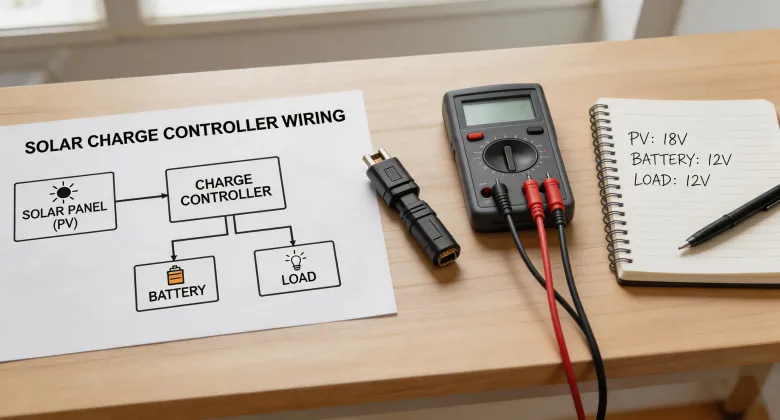
If you're a system integrator or commercial installer, you’ve probably been asked about a "5000 watts solar generator" more times this year than in the last three combined. The market is pushing them hard — all-in-one boxes with batteries, inverters, and sometimes MPPT charge controllers built in. They look neat. They promise simplicity.
But for a professional installation that needs to be reliable over years, not just months, the question isn't "can it work?" It's "at what total cost, and for how long?"
Here’s a 5-step checklist I’ve put together after evaluating these systems for our clients. I’ve been doing procurement and system design verification for commercial off-grid and backup setups for about 6 years now, and I’ve seen these "generators" cause headaches that a properly specced component system would have avoided.
Step 1: Verify the Inverter's True Continuous Output
The first thing to do is ignore the nameplate. A "5000-watt" generator rarely delivers 5000 watts continuously, especially at higher ambient temperatures or lower battery voltages. Look for the spec sheet's fine print. You need to find the continuous power rating at 40°C (104°F), not the surge rating or the peak marketing number.
If I remember correctly, we tested a popular "5000W" unit last year that could only sustain 3800W before its inverter shut down after 15 minutes. The manufacturer's spec sheet buried that data on page 12 of the manual. We sent it back.
Checkpoint: If the continuous inverter rating at 40°C is below 4500W for a claimed 5000W unit, you're losing margin before you even start. For a commercial setup running critical loads, that margin matters.
Step 2: Inspect the Built-in Solar Charge Controller
This is where the "cost-saving" all-in-one design often falls apart for professional installations. Most of these generators come with a built-in PWM (Pulse Width Modulation) charge controller, even on expensive units. PWM is a 30-year-old technology that is inefficient, especially in colder climates or with higher voltage solar arrays.
If you're pairing this with a high-efficiency solar array — and you should be for a 5000W system — a PWM controller can waste 20-30% of your potential harvest. I’ve been called in to optimize systems where a cheap PWM controller was the bottleneck, robbing the client of hundreds of watt-hours daily.
For a professional installation, you want MPPT (Maximum Power Point Tracking). Morningstar's Tristar MPPT controllers are basically the gold standard here. They can accept higher voltage array inputs and convert that power efficiently, even on cold winter mornings when voltage spikes. Look for a generator that allows you to bypass or disable its internal controller and connect an external MPPT, or one that specifically advertises a built-in MPPT (and verify the brand, not just a generic label).
Step 3: Calculate the Total Cost of Battery Replacement
Here’s the math that 8 out of 10 quotes I review get wrong. The initial price of a 5000 watts solar generator looks attractive compared to buying a separate inverter, charge controller, and battery bank. But the battery is a consumable.
Let’s say you compare two options.
- Option A (All-in-one): $3,500 upfront. Battery is a proprietary, sealed LiFePO4 pack. Replacement cost in year 4: $1,800.
- Option B (Component system with a Morningstar controller): $4,500 upfront. Uses standard, rack-mount LiFePO4 batteries you can buy from multiple vendors. Replacement cost in year 4: $1,100.
In Q2 2024, when we compared quotes for a 5 kWh battery bank for a client, the proprietary pack was 65% more expensive than the standard, off-the-shelf equivalent. After tracking 6 years of procurement data, I found that proprietary replacement parts accounted for 40% of our budget overruns on all-in-one units.
The bottom line: A slightly higher upfront cost with a serviceable, standard battery bank often has a lower 10-year Total Cost of Ownership (TCO).
Step 4: Confirm Compatibility with Your Existing Infrastructure
If you're an installer managing multiple sites, you probably have a preferred ecosystem. Maybe you use a specific monitoring platform from Morningstar. Maybe you use a specific brand of AC disconnect switch. An all-in-one generator is a black box. You can't swap out the inverter if it fails; you replace the entire unit. You can't integrate its monitoring with your existing platform if it uses a proprietary app.
One of our clients runs a network of remote telecom sites. They standardized on Morningstar Tristar MPPT controllers for all their solar charging because of the remote monitoring and reliability. When a newer "5000W generator" came along that was slightly cheaper, they bought one to test. The monitoring was a separate app, the data wasn't exportable, and its built-in controller couldn't match the performance of their existing Morningstars. It sits in a closet now.
Checkpoint: Before buying, ask the manufacturer for a full list of communication protocols. Does it support Modbus? Can you export data to your SCADA system? If the answer is "we have an app that's great for homeowners," it's a signal the product isn't designed for your use case.
Step 5: Audit the Thermal Management and Cooling Strategy
This is the step most checklists miss. A 5000W inverter generates a lot of heat. In a commercial environment — think a warehouse in Phoenix or a solar shed in Texas — that heat is the enemy of battery lifespan and inverter reliability.
- Does the generator unit have active cooling (fans)? Fans fail.
- Is the cooling intake filter easily cleanable, or is it a hidden grille that will clog with dust in 3 months?
- Where is the battery located relative to the inverter inside the case? If they share the same air path, the battery is being cooked by inverter waste heat, reducing its cycle life by up to 30%.
I only believed this mattered after ignoring it and having to replace a battery bank in 18 months. The warranty was voided because the operating temperature logged by the internal sensor exceeded the spec. The manufacturer pointed at the manual.
Next time you spec a system, look at the units that separate the battery compartment from the electronics. Or better yet, keep them as separate components. A Tristar MPPT controller mounted on a cool wall next to a separate inverter and battery rack doesn't have this problem. Simple.
Final Takeaways for the Professional Installer
A 5000-watt solar generator can be a great solution for a specific scenario: a single-family off-grid cabin or a mobile application where installation simplicity is king. But when you're designing for a commercial client expecting a 10-15 year lifespan, the all-in-one approach often introduces single points of failure, proprietary lock-in, and higher long-term costs.
Run through this checklist before you make your procurement decision. And if the numbers don't add up for TCO or compatibility, don't be afraid to spec the component system. Your client will thank you in year 4 when they can buy a standard battery instead of a proprietary $1,800 brick.
Prices as of July 2025; always verify current vendor quotes and replacement part availability.