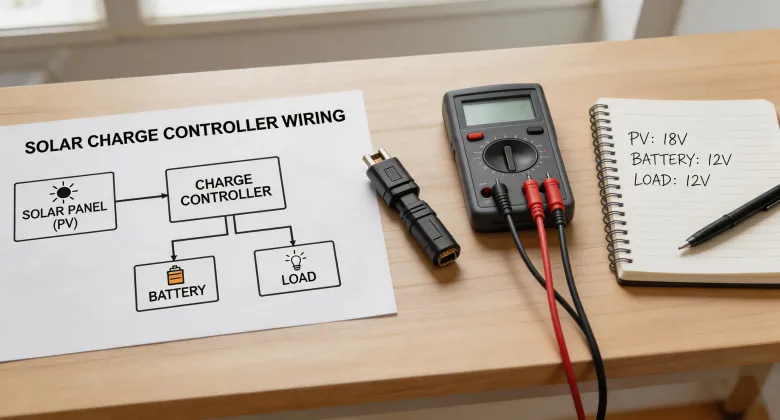
Quick answer: if a Morningstar solar charge controller won't charge your LiFePO4 battery, the controller is usually not the problem. The battery profile is wrong, or the BMS is in protection mode. In September 2022, I signed off on a $3,200 off-grid order without checking either one. The system failed commissioning, the rework cost about $890, and we lost a week on the schedule. The fix was two settings and a BMS wake-up signal. Most 'LiFePO4 battery won't charge' cases are preventable with a 5-minute pre-wiring check.
I've been handling design review and troubleshooting orders for Morningstar products for six years. I've made—and documented—14 significant mistakes, totaling roughly $18,000 in wasted budget. Most of that damage happened in my first two years. Now I maintain our team's commissioning checklist, and in the past 18 months, it has caught 47 potential errors before a site visit. The checklist is not clever. It's just the stuff I learned by getting burned.
Why your LiFePO4 battery won't charge (and why I ignored this until it cost me)
Everything I'd read about lithium batteries said it was all about voltage. In practice, with Morningstar products, it's also about the BMS state. A TriStar MPPT or ProStar controller set to a generic sealed-lead battery profile will often show the bank as full or not charging because its target voltage is too low. Meanwhile, the BMS might have disconnected after a deep discharge or an overcurrent event. It won't accept current until it sees a small input voltage to wake up. So the bank sits there looking dead, and the charge controller looks like it's failing.
The first thing I check is the controller's battery profile. Morningstar's MPPT controllers support custom set-points. For a typical 4S LiFePO4 bank, set absorb voltage to around 14.4V, float to around 13.5V, and disable equalization. I know 'checking the datasheet' sounds like advice for beginners. I stopped doing it after a few successful installs, and then the BMS tripped during an extended float stage because I left equalization on. That was the $890 mistake. I only believed the warning after ignoring it.
I don't have hard data on how often this occurs across the industry. What I can say anecdotally is that maybe 8-12% of our first-time commissioning calls involve a LiFePO4 BMS wake-up issue. It's the most common avoidable call we get.
A note on 'pool solar controller' (not the same thing)
The term 'pool solar controller' brings a surprising number of confused installers to Morningstar product pages. I say 'surprising' because I've been on the other end of that confusion myself. A pool solar controller for solar pool heating is usually a differential temperature controller. It switches a circulation pump on when the collector is hotter than the pool water. That's not a solar charge controller. Morningstar makes charge controllers and remote monitoring products, not pool thermal controls.
Now, if you need a charge controller for a battery-powered pool pump, that's different. A Morningstar solar charge controller can be part of a 12V or 24V DC pump system with a load-control terminal. But I once had a customer who wired a TriStar to a thermal circulation pump because the word 'pump' appeared in both diagrams. The controller didn't fail. The pump did. I should have asked one clarifying question on the order call. Now our pre-order checklist asks, 'Are you controlling battery charging, or are you controlling a thermal collector?' The answer changes the equipment list completely.
How big is a 10kW solar system? Bigger than the math looks
The 'how big is a 10kW solar system' question usually comes up during proposals. With 400W panels, 10kW means about 25 panels and around 525 sq ft of module area. The physical footprint isn't where I've lost money. The electrical footprint is.
A 10kW array charging a 48V battery bank can push more than 200A through the charge controller output at bulk charge. One 60A Morningstar TriStar MPPT cannot carry that alone. I designed a 10kW system that way once—one 60A controller, 'the math says 208A, so it'll just limit,' I told myself. The controller wasn't broken; it was current-limiting all day because I was running it beyond its continuous rating. We added a second TriStar MPPT and split the array. The controller actually worked the whole time. I was the problem.
According to Morningstar's TriStar MPPT specifications (morningstarcorp.com), output current rating is what matters—not the array wattage. That sentence sounds obvious, but it's exactly what I got wrong. And it's a more expensive lesson than the physical 'how big is 10kW' answer.
The 5-minute checklist my mistakes built
This is the list we use before every Morningstar system commission. It's not a substitute for the manual—different Morningstar controllers have different menus, and firmware versions change. Verify set-points against the current product documentation before trusting the defaults.
- BMS state: Is the LiFePO4 BMS awake and not in protection? If the terminal voltage is near zero, wake it with a small charge before connecting the controller.
- Battery profile: Are absorb and float voltages set for the actual battery chemistry? Is equalization disabled for LiFePO4?
- Output current math: Array wattage ÷ battery bank voltage. If the answer exceeds the controller's continuous output rating, add another controller or raise the battery voltage.
- Load type: Is this a charge control application, or is the client actually asking for a pool solar controller? They are not interchangeable.
- Physical array size: For a 10kW system, confirm the client has room for 25 panels at 400W each (around 525 sq ft of module area), plus access spacing and the required setbacks.
I wish I had tracked our first-time commissioning pass rate from the start. I really should. What I know is that after we added the checklist, the 'it doesn't charge' calls dropped noticeably. Not to zero—mistakes still happen. But they're smaller, caught earlier, and usually fixed in the office instead of on a roof.
The lesson I keep repeating to our installers is the boring one:
Five minutes of verification beats five days of correction.
I can't undo my $18,000 of mistakes, or the fried pump, or the second TriStar. But the next person doesn't have to repeat them.